How do we know what God is calling us to?

Have you ever felt certain that God was calling you to do something, so you do it, even though you cannot see why you should do it, but it doesn’t lead to the outcome that you expected?

Looking back can you then see why God called you to do it?

There are plenty of people in the Bible who were called to do things for which they could see no reason, or which they didn’t want to do – particularly the latter – but who with hindsight we can see needed to do what they did.  Jonah, Jeremiah, Amos.

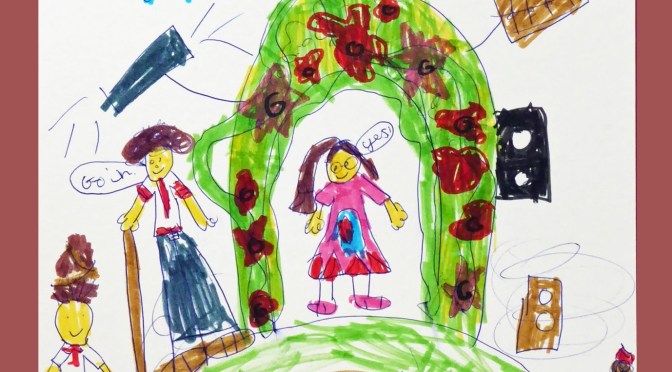
I suspect that the picture above is meant to be interpreted as joy at being picked, but I think it can also be interpreted as anger!


What is our reaction when we feel that God is calling us to something?  And if we don’t think it is the right thing to do, can we trust God enough to do it without concerning ourselves with what we think the consequences might be?

What is transferable?

Last night I was speaking with someone who has just changed their job, and they were talking about their new role, and the things that they were learning.  Much as with yesterdays post, where I learnt from a new experience, it struck me that when we do something new, in any sphere of life, it can at the very least illuminate something about our faith journey and service.

Looking back over my life I find it amazing how many of the things that I learnt in industry are applicable (perhaps with adaptation) in the church.

I was once told a story of how someone was introduced to the Bishop as “our head sidesman (sic)”, when in his day job he was CEO of a reasonable sized company.

God does not just work with us in church, but in the whole of our lives.  We can take things that we learn outside the church and use them to the benefit of the church and vice versa.  (We can also take the church into work – but that is a different post).

What skills have you developed outside the church that you can bring in?  And what have you learnt inside the church that you can take out?

Welcome – for who?

Lesley and I have decided to start playing bridge and have been to a couple of local clubs to see about joining.  You may wonder why I am writing about this, but it is because of our different experience of welcome in the two clubs – and the insights that that has given us about welcome in church.

To be fair to the two clubs I suspect that they have a different emphasis – one is focused on the playing of bridge, and the other is more social.  I am not saying that one is right and one is wrong – rather questioning who it is for.  If you know how to play bridge, what to do when you get there and your main concern is to turn up, play your bridge, focusing on the game, and go home then one club is better for you; if you want to chat a little as well as play bridge then perhaps the other.

That translates quite well to church – there are churches for the afficionados; places where those in the know can go and focus on what they want to focus on, but where newcomers can feel a bit lost.  Then there are churches where perhaps the service is a little more flexible, but where newcomers can feel more included.

There is a place for both, and indeed I believe that Willow Creek hold mid week services for the leadership, with Sunday services being focused on newcomers.

The challenge is what kind of church are we, and what kind of church are you?

All are welcome in this place

As has been written about elsewhere on this site we are looking at becoming members of Inclusive Church, and during August are preaching on this.  Yesterday I spoke on an inclusiveness which isn’t one of the six areas that IC is focusing on, but which is close to my heart, and that is the inclusiveness of different beliefs.

I said that I wanted a big tent Christianity, where all are welcome.  I was heckled with “what about devil worshippers”, and agreed that they might be an exception, but afterwards I was challenged on this.  I was also challenged on whether the church has a role in enforcing behaviour.  To take the last first; the parable of the weeds and the wheat says don’t tear up the weeds for fear of tearing up the wheat – let God judge (I paraphrase), and Jesus says:

Do not judge, so that you may not be judged.

The Church has been wrong in the past, is no doubt wrong at times now, and will no doubt be wrong in the future.  How can we be sure that we are judging with God’s eyes?  And given the quotes above, why would we even try?

The first question leads on from this – if we do not judge, then why would we exclude others?  This does of course lead to the classic permissive dilemma, what do I do with people who wish to judge others?

It perhaps comes down to what you think church is – is it a place for the elect, the saved (a form of Calvinism), or is it a place for pilgrims on a journey?

If you believe the former, then what I am saying makes no sense; if the latter then it hangs together.

As for the problem of those who disagree with me, whilst I may invite them into my big tent, most will decide that it isn’t the place for them.  However, this is not to say that I want a (wider) church without them – but that is a different issue!

Where I was curate we often sang this hymn: All are Welcome in this place.  Amen.

Your church needs you(r money)

It would be nice to think that the practice of religion could be conducted without having to worry about such secular items as paying bills and general self-sufficiency. However, unless you’re going to go out in the desert, climb up a pole and generally shun society to conduct your devotions, this is unlikely to be the case.
Basically any church, regardless of denomination requires the congregation to contribute to its upkeep. The Church of England, even though it is the established church with the monarch as its head, is no different in this regard. We get no contribution from the diocese, from central government or the extensive royal estates.
The parish budget is divided roughly into two areas: the general fund, which deals with the day to day running expenses, including salaries; and the restricted funds which are reserved for specific purposes, e.g. building repairs or outreach. It all comes ultimately from the contributions of parishioners.

You may have heard people talking about “the Parish Share”. This is the major outgoing part of the general fund (about 65%). It goes to the diocese. Most of it comes back in the form of salaries of clergy and their housing. A smaller part is associated with such things as training and diocese administration. The ability to pay the parish share is regarded as an indication of the viability of the parish. We’ve managed for the last three years. It’s going to be a challenge this year.

This year, the budget predictions indicate a general fund expenditure of £104,000 and an income of £84,000, a shortfall of £20,000. We also have a problem with the special funds, particularly the part associated with building maintenance. We’re almost out of money here, after carrying out necessary repairs and modifications to each church.

On a personal note, when I was studying the figures in order to give a presentation on this problem to the churches recently, I looked at my own monetary contribution. I thought it was quite substantial. However, I then figured out how much I spent per week on coffee in various establishments and car parking charges in Farnham and Guildford etc. The amount I give to the church is comparable, or possibly slightly less, than these numbers. I think the parish is arguably more deserving, and certainly has a greater need of my money, than Starbucks!

You will be able to make similar comparisons based on your own lifestyles.

The most effective way to give is via the parish giving scheme. This is a direct debit system. If you are a taxpayer you have the option of donating gift aid. You can also choose to index link your contribution. If you don’t pay tax, we can claim tax relief on the amount collected in the collection plates, so you may want to consider this option. We would prefer to phase out the old collection envelope scheme, as it costs a lot in both time and money to administer, and technology has moved on since this was regarded as the clever way to contribute.

So, come on everybody. If we look at the numbers attending the church, we are a growing parish. However, the income isn’t reflecting this. I’m afraid the days of putting loose change in the collection plate are long past. I’m significantly increasing my direct debit, or, as Alan Crawley neatly, and delightfully ambiguously, summarised when I gave my presentation to St Mark’s,

“I’m upping mine, up yours (!)”

Bob Shatwell

A Non Anxious Presence

A while ago Lesley and I did a course and they encouraged us to be a non anxious presence.  You may wonder what that means – though it is self explanatory!

Do you recognise that some people seem to carry anxiety?  Just being in their presence makes you feel anxious?

Do you recognise the things that make you anxious?

  • Fear of what other people may think of you?
  • Fear of doing something wrong?
  • Fear that you aren’t good enough?
  • Add in your own favourite fear here!

One of the most frequent set of words in the Bible is “Do not be afraid” (67) or “Do not fear” (58).

If we can give up on our own desires and trust in God (and I’m not saying this is easy) then that anxiety fades away.  If instead of wanting a particular outcome we can desire that God’s will be done, then what is there to fear?

And if we can present a non anxious presence to others it can be catching, helping them to let go of their fears (well, sometimes).

Young Preacher of the Year competition launched

The Diocese of Guildford has launched its first ever preaching competition for young people. Open to any young preachers with a connection to the diocese, the competition aims to encourage young people to give preaching a try, and to find creative ways in which we can hear the voices of young people.

The sponsor of the project, Bishop Jo Wells, the Bishop of Dorking, said: “I am delighted to launch ‘Young Preacher of the Year’ across the Diocese. It provides an opportunity for any young person aged 14 to 18 to have a go at preaching, and for others to discover budding preachers in their midst.

“Giving young people a voice and a very public platform is vital if we are to be ‘transforming church, and transform lives’ as we proclaim in our vision.  If you are aged 14 to 18 and think this might be for you, we’d love you to enter. All are welcome to enter regardless of experience or qualification.”

The prize for the competition includes both a trophy and the opportunity to preach from the highest pulpit in the area (well above sea level anyway) – the one in Guildford Cathedral.

Entrants must be in school years 10-13 in September 2017 (aged 14-18). Entry is simple – just record yourself preaching for 3-4 minutes on your mobile phone and complete the short entry form on the competition website. More information here www.youngpreacheroftheyear.co.uk

Closing date for entries is 5th November 2017. For a poster to display in your church or school see www.youngpreacheroftheyear.co.uk/poster

To find out more about the Young Preacher of the Year competition, contact organiser David Welch, Diocesan Youth Adviser, by email to david.welch@cofeguildford.org.uk

How do we exercise our duty to warn?

This morning one of the readings at Morning Prayer was Ezekiel 33.1-20, which tells Ezekiel that he is to warn people of what God tells him to, and that if he doesn’t then on his head be it (I paraphrase).

This passage set me thinking as it can be used to justify telling all sorts of people that what they are doing is sinful – often done in an unhelpful way.  But, if we are called to tell people then don’t we have to do this?

My thinking led me to two places; not everyone is called to be a sentinel – God calls prophets and God gives them the message to be passed on.  Most prophets are unsure of their calling (eg Jeremiah) and are careful to pass on God’s word.

Secondly, the sentinel is called to give a warning; we can speak the truth and not communicate.  The words which communicated a long time ago do not necessarily communicate today.  Attacking people, insulting people, abusing people does not communicate.  If we are called to warn people then we are called to do so in ways in which they can understand.

An example, many years ago I worked in a team where we enjoyed winding each other up.  One day the main culprit was out at lunch when his wife phoned saying she had locked her key in the house, please would he come and let her in.  We gave him the message, but while we did so everyone else was smirking.  He refused to believe us and wouldn’t go home, even when we stopped messing around.

So the questions for people called to this ministry are:

  • Are you sure God has called you to this ministry?
  • Are you communicating God’s message in a way that it can be heard?

Broken Bread

Yesterday’s reading, of the feeding of the 5,000 includes:

Taking the five loaves and the two fish, he looked up to heaven, and blessed and broke the loaves, and gave them to the disciples, and the disciples gave them to the crowds.

Which is very reminiscent of the Eucharist, where we take bread, bless it, break it and give it.  It is also very reminiscent of the christian life where God takes our life, blesses it, breaks it and gives it to others.

The breaks sounds perhaps a bit worrying, but our lives, when we first encounter God, are often clenched tight, and need breaking open to allow God’s love in.

Inclusive Church

The Parish is considering signing up to Inclusive Church, an organisation which encourages churches to look at who might not be coming into church because for some reason they feel it isn’t for them or they cannot do so. The reasons may be many and varied – perhaps it is an economic issue, culture, race, disability, a mental health issue, sexuality. Inclusive Church encourages churches think about these reasons and can help churches be truly welcoming.

Many churches and individuals have joined Inclusive Church and they are united around the following statement of belief:

“We believe in inclusive Church – church which does not discriminate, on any level, on grounds of economic power, gender, mental health, physical ability, race or sexuality. We believe in Church which welcomes and serves all people in the name of Jesus Christ; which is scripturally faithful; which seeks to proclaim the Gospel afresh for each generation; and which, in the power of the Holy Spirit, allows all people to grasp how wide and long and high and deep is the love of Jesus Christ.”

On July 23, the Very Rev’d Dianna Gwilliams, Dean of Guildford Cathedral and chair of Inclusive Church, visited St Mark’s and spoke about joining Inclusive Church and it was decided that during August the clergy will preach on different aspects of inclusion and then the PCC will vote on the parish joining.

Stella Wiseman

Serving the Villages North of Farnham: Badshot Lea, Hale, Heath End & Weybourne