More thoughts on Remembrance

I recently posted some thoughts on Remembrance Sunday, and yesterday I had some more that I thought worth sharing.

In the previous article I commented on an article by Simon Jenkins, and he suggested that we should make next year the last Remembrance Sunday because too many use remembering as a means to keep past hurts alive.  However, it struck me that the problem is not keeping the memory alive, it is keeping the animosity alive.

Desmond Tutu has written a book on Forgiveness with his daughter Mpho.  This puts forward a four step approach to forgiveness, summarised here:

Telling the Story
Naming The Hurt
Granting Forgiveness
Renewing/releasing the relationship

It strikes me that at Remembrance the difficulties come because we are good at the first two, but don’t always move on to the third or fourth.

I would suggest that until we have mastered those two steps as well the nursed grievances will remain whether or not we abolish Remembrance Day.

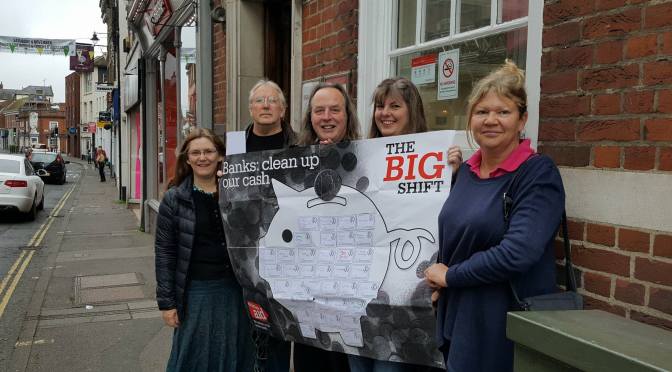
Prudence the Piggy went to HSBC

rudence the pig visited HSBC Bank in Farnham last Thursday to ask the bank to stop investing in fossil fuels and instead put its money into renewable energy.

Prudence bore the signatures of members of the churches of St George’s, St John’s and St Mark’s in the parish of Badshot Lea and Hale, and was presented to the bank by the Reverends Lesley and Alan Crawley, joint rectors in the parish, along with parishioners Helena and David Walker and Sorrell Price.

Lesley Crawley explained that the pig was a petition and was part of the Big Shift campaign by the charity Christian Aid to ask the banks to change where they invested their customers’ money and to put this money into renewable energy for the sake of the planet.

She told a representative of HSBC: “We want the bank to divest from fossil fuels and invest in something either neutral or good to help counter climate change.”

HSBC agreed to accept the petition and to send it to head office, where it will join others from around the UK.

Rev’d Crawley added: “Laura Mead, the regional co-ordinator at Christian Aid, contacted all the banks in Farnham to ask them to accept the Big Shift petition, but HSBC was the only one who would receive us.”

For more information on Christian Aid’s Big Shift campaign, visit www.christianaid.org.uk/campaigns

Stella Wiseman

Reading the Bible

Today’s post was inspired by Pray as You Go (not there for long), and by last Wednesdays  group discussion on the Bible.  The reading was Luke 16:9-15, and began:

And I tell you, make friends for yourselves by means of dishonest wealth so that when it is gone, they may welcome you into the eternal homes.

This surprised me as it was a memorable phrase, which I did not remember!

Looking it up I discovered that it follows on from the Parable of the Unjust Steward, so when I usually read/hear it it is in a particular context.  The words are the same, but the context is different (not that the unjust steward is an easy parable to interpret).

It isn’t in the same league as theatre bill boards (see here), but reading something out of context can give a misleading perception.

The question then comes – how do we use the Bible without taking it out of context?

Remembrance Sunday

This coming Sunday is Remembrance Sunday, and this morning I read this by Simon Jenkins.

For many clergy Remembrance Sunday is a struggle – how to remember the fallen with dignity, whilst remembering what has happened and wanting to say “never again”, often in the context of military parades.  The last thing that many of us would want to do is to preside over “a validation of war by embracing its horrors in religiosity”.

However, my experience in church is that when we struggle to achieve that balance it is welcomed.  Whether that is a generational thing, as in many churches, including ours, there are still people who can remember the war, I don’t know.  And of course, although Remembrance focuses on the two world wars, there have been many conflicts since, and many killed or injured.

If I were to be provocative I might ask whether the problem is that we don’t remember the more recent conflicts enough!  People under 70, which includes most politicians, have no experience of a “big” war.  Perhaps if our politicians had, or we Remembered better the smaller wars, there would be less inclination to solve our problems by military means.

What is a priest?

Over the years I have heard a number of priests complaining about the increasing amount of management coming into the role of incumbent.  Until now I have thought it only sensible that the good bits of modern organisational management theory should be used by the church.  However…

Recently the Church of England has adopted new safeguarding procedures, and we have recently been made aware of the GDPR that are coming into force in May 2018.  Both of these have added significantly to the administrative overhead of running a parish (and that is before the impact of implementing them is considered).  If you are in a parish with several retired managers then this may be dealt with by them, although there is a level of knowledge required that the incumbent probably has in their head that anyone else will spend time finding out.  But if you are in a parish without those kind of people the burden falls on the incumbent – and in some of those parishes the incumbent is already doing more administration than in others, perhaps no administrator, and I have heard of some with no treasurer.

This is not a plea for the church to be exempt from either of these – there is good reason why they are needed.  However, it is a plea for the national church or dioceses to look at ways to reduce the burden of them on parishes.  I will admit that this is a hobby horse of mine, but in the era of the internet providing systems centrally for use across the country is not rocket science, and could just help!

And for those parishes who do have people who can do these things – wouldn’t their time be better spent on ministry rather than administration?

Sunday 29/10/17 – Hospitality – Matt 22:34-46 by Craig

It’s been a tough time for Jesus. Today’s Gospel reading is one of the final disputes between him and the religious leaders, their attempts to entrap him into uttering blasphemy, and sealing his own fate.
This is a pattern in the Gospel that we’ve followed over the past few Sundays: from the beginning of Chapter 19, as he leaves Galilee for Jerusalem, he has been almost constantly quizzed and hounded by the Pharisees and Sadducees, the two main parties in the Jewish religious hierarchy.

This tension rises sharply after Jesus’ outrageous entry into Jerusalem riding on a Donkey, with all the prophetic implications that raised. If you read from the beginning of Chapter 19 to today’s reading in one sitting, you will sense the momentum of Jesus’ destiny.

The Pharisees had a very legalistic take on God’s commandments. Over the centuries, the original ten had burgeoned into 613. No wonder the ordinary Jew found it almost impossible to find God: there were too many rules, too many hurdles to jump, with the Pharisees in their self-appointed role as guardians of the faith; God’s policemen, always looking to trip them up.

So, this encounter between Jesus and the Pharisees is a fitting end to the legal wrangling, arguments, and ‘catch-him-out’ questions that have been going on. Jesus distils the commandments of God into two. The 613 rules are now redundant. When pressed by a lawyer ‘which commandment in the Law is the greatest?’ Jesus replies with two:

‘The first is this: love the Lord your God with all your heart, with all your soul, and with all your mind….And a second is like it: you shall love your neighbour as yourself.’

First; and second. I don’t believe that you can observe one of those commandments without the other. They are held together in an intricate and live-giving tension. We can all ‘know’ our neighbours, but the challenging thing is that loving them takes loving God wholeheartedly.

Without that we can never see them through the eyes of God, or with the mind of Christ. That makes me feel very uncomfortable. Some ‘neighbours’ that I encounter on a daily basis (and that’s not just the people who live next door) sometimes try my patience: how can I love them as I love me?

Yet I feel it is right for us to dwell on that phrase ‘you shall love your neighbour as yourself’ and just ask the question: how can we do that?

You may recall my Ministry Team letter in the last edition of the Parish Magazine, where I wrote about the Christian tenet of ‘hospitality’, especially our experience of it when we first came to St George’s (11 months ago!). It was wonderful! Up until then, our experience of hospitality in a church usually involved ‘fitting in’, which the outspoken me has never been comfortable with!
If you read it, you will also know that I am an ‘Oblate’ (Lay Member) in the Benedictine community at Alton Abbey. Hospitality is a central tenet of the Benedictine way of life. In chapter 53 of his Rule, St Benedict urges the Monk to ‘welcome the stranger as if Christ himself were present, for in them, Christ himself comes.’ Strangers are our neighbours too.

Hospitality in the Monastery is manifested in the warmth of welcome, sustenance, love, care, and space underpinned by the cycle of worship, work, and prayer. We found all those things when we first came to this church. Jesus and Benedict seem to be saying similar things, and whilst we perhaps find it relatively painless to do within our church community, how can loving our neighbours as ourselves work out in our Parish?

Our first natural thoughts are likely to be: ‘what can we do? What action can we take? What ideas, and events will demonstrate that we love them as much as we love ourselves, and welcome them as if welcoming Christ himself?’ We’re culturally conditioned from birth to be ‘busy’, to ‘do stuff’, it’s just how we are. And I must say that there is nothing much wrong with offering tangible and practical things to our village.

But – through activity, we can often squeeze out opportunity, and become unavailable to the neighbour, the stranger who calls. I’m dreadful: ‘Hello, welcome to our church…. here’s a bundle of leaflets, this is what goes on…. sorry I’ve got do such and such, can’t stop to chat’. And I’m gone. What have I missed; more importantly, what has my neighbour lost out?

In the monastery, it’s different – apart from the usual daily cycle of worship, work, and prayer, there is no programmed activity. Space is intentionally left for those who call in for a chat, a pray, and so on.

The perfect environment to simply ‘be’.

That would never work in our Parish of course, so I’m not suggesting that we open St George’s Abbey! But I do think that we ought to ask: are we really available to our neighbours?

Folk in this village, and beyond, are longing for a break from the relentless pressure to be something, to be seen to live up to certain standards. Working all hours. Keeping up with the bills. Driving the children here and there to this and that activity. Time poor, no opportunity to simply be.

How can we be more available? Being available rather than doing ‘stuff’ – I have no simple answer. One example of hospitable availability is the Christmas Midnight Mass. Starting it at say 10pm might make it convenient for some of us, but what about the once-a-year visitor who longs for a glimpse of something beyond the Christmas drudge? They turn up at 11.30pm, and the church, and its people are unavailable….

So what’s my cunning plan? I don’t have one – as such. The hospitality I speak of can only come through the discipline of prayer, meditating and mulling over scripture, and regularly receive the Eucharist. All these things are our food for the journey. Things that will help us to love the Lord our God with every thing and faculty that we have.

At the end of John’s Gospel is the story of the Disciples out fishing one night. The events leading up to Jesus’ death had crushed them, heads and hearts spinning from the relentless pressure: emotional, physical, spiritual… Since his resurrection, he had appeared…and disappeared. God must have seemed strangely absent, just as the fish were too.

They spot Jesus after he gives them a clue where to cast their nets. He’s cooking breakfast. When they came ashore, they simply received his hospitality – he had made himself available. He fed them. Chatted. In that space and in that fellowship, they got a glimpse of something beyond, a new sense of purpose, and really knowing that they are truly loved.

Our neighbours are desperate for this intimate encounter with the mystery of God. So, here’s the plan – let’s consciously deepen our love and devotion for the Lord our God, with all our hearts, with all our soul, and with all our minds.

Let’s come to communion with a deep sense of longing for a renewed sense of loving our neighbours.

Loving them through the eyes of Jesus, in which our neighbour can get a glimpse of glory, and find ointment for their sore and hurting souls

Photos of the Arts at St Mark’s Festival

On the weekend of 20-22nd October St Mark’s held an Arts Festival, organised by the energetic and talented Bob and Lesley Shatwell. It consisted of an exhibition, concert, workshops, ceilidh and festival service… a mesmerising, colourful exuberant weekend celebrating art and the people of this parish. Here are some photos:

This slideshow requires JavaScript.

What challenges us?

I was reminded by a recent sermon of Craig’s that when preaching it is good to tackle the bits in the passage which challenge us.  Indeed, at a previous church, the congregation asked the clergy to specifically address this (rather than preaching on an alternative reading).

They also say that the best sermons are those that are addressed to yourself.

Note to self – remember this and act on it!

Remembrance Services

On November 12th the following services of Remembrance will take place:

In Hale the 9:30 Service at St John’s followed by 10:45 at the War Memorial then a 11:15 Service all-age at St Mark’s.

In Badshot Lea the 10:00 Shortened Service at St George’s followed by 10:50 at the War Memorial.

In Weybourne a service at 4pm at the War Memorial followed by refreshments in the Village Hall.

Serving the Villages North of Farnham: Badshot Lea, Hale, Heath End & Weybourne