Tag Archives: Christianity

The Work Begins!

St John’s tower restoration

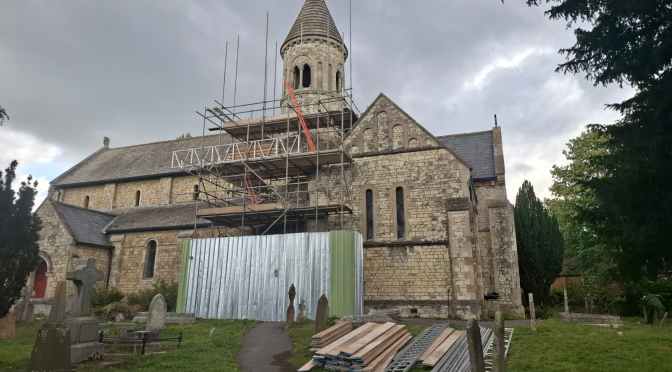
The scaffolding is up and work is about to begin to restore the crumbling tower at St John’s. This is thanks to the generosity of individual donors and grant-awarding bodies, and the hard work of parishioners who applied for grants and put on fundraisers to find the cash for the repairs.

The work will cost at least £32,500 and we’ve been raising the money for several years through a mix of grants, fundraising events and donations. At the end of July, we launched a final push to find the last £5,500 so that the stonemason could start in September. Publicity, including in the Farnham Herald, brought forth a flood of donations meaning that Anstey & Stone, stonemasons, can begin work now.

Rev’d Lexi Russell, rector of the church, said: “Thank you so much for the incredibly generous donations which have been made. They mean that a Hale landmark which has stood there for generations past will be standing for generations to come.

“We do know that because the church is old – it is 181 now – it is very likely that there will be more work needed and we will need more funds, so please, if you feel able, do continue to donate. And thank you all again for what you have done.”

Restoration work is expected to take six weeks to complete and should be finished by the end of October. In the meantime, further fundraising events are in the calendar, including a concert of 60s music by popular Farnham band Out of the Shadows on the afternoon of September 27, starting at 2pm. Information is available here. There is also a fundraising page here.

If we raise more money than we actually need for the tower itself it will go into a fund specifically for work on St John’s and will not be spent on anything else.

Pamela’s Licensing

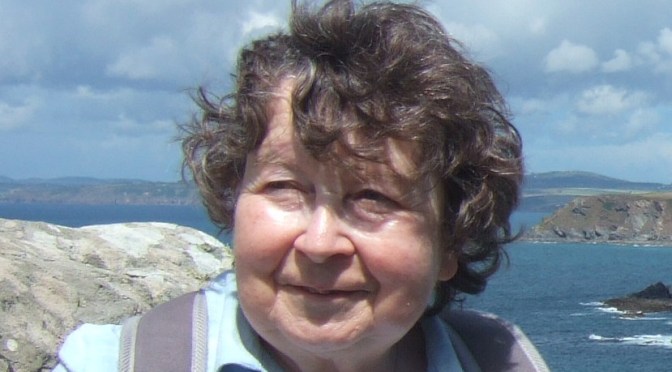
Pamela Marsham will be licensed as a Lay Associate Minister at Guildford Cathedral on Saturday, July 5th at 10.30am.

As a Lay Associate Minister, Pamela will continue work alongside Lexi and the rest of the ministry team. Her course has focused on preaching, teaching and discipleship and she has also done the diocese’s Worship Leaders Course.

“That for me is the most important as my focus is on leading worship. and Lexi is keen for me to continue to do that,” says Pamela. “I have been lucky really, in that I have been able to gain experience in this while training.”

During the course, Pamela particularly valued meeting others who were on the same path as she was. She adds: “We were all on a journey and it was exciting as we didn’t really know what it would actually lead us to do.  I think there are some in the group who will continue the journey and probably go on to train to either be LLMs or even become ordained.  Those roles are definitely not what I will do as obviously age is against me but I can lead worship and that is a great privilege.  I hope, too, that I am showing that age is not a barrier to serving God. 

“I am also reading more theology and am constantly learning more about what the Scriptures teach us.”

Tickets to the licensing have been allocated but if you would still like to attend you can do so and can have unreserved seating which will be towards the back of the cathedral.

The invitation

Instead of a sermon on June 23rd, there was a story/imaginative exercise. The congregations at St Mark’s and St John’s heard the Gospel reading Luke 14: 16-24 about a banquet which a man’s respectable friends refused to come to. You can read it here.

This was the story:

I want you to picture something. You have received an invitation to dinner. When you ring the door of the house it is opened by a woman who smiles at you says “Welcome.”  But you feel there is something a bit odd. She is big for a woman and her voice is deep.

You follow her through the house to a room with a huge wooden table and chairs all around. The table is set for dinner and candles on the table make it warm and inviting.

Two men come in, they are holding hands and they greet the woman there “Hello Rachel,” they say.

So she must be a woman.

“Ed, Mike,” she says. “Do sit down.”

Then another person comes in. They are young, boyish, but you are not sure. Is this a young man, or a young woman?

Others arrive. Some of them are alone, some are in pairs, all ages, casual, smart, men, women and those you really don’t know about.

“Come and sit down,” says Rachel, but you feel shy, nervous. Are you in the right place? And who are all these people? They don’t look like the people you normally mix with. You are not sure you fit it.

Then someone else comes in from a door behind you and stands next to you. He greets you by name and you feel that you know him, have always known him. He has such a kind face, the kindest you have ever seen. Maybe it will be alright.

Rachel comes over to him and hugs him and he hugs her tight. Then he waves at someone else and others come over. There is a lot of laughter and hugging and also the food smells amazing. Fresh bread, fish, spices, wow!

You are so hungry.

But you hold back. Is this the place for you? The people seem friendly and happy but they are different. You’re not sure that you should be there or be seen with them. You turn and decide to head out, but maybe you will pop into the bathroom on the way out. You are heading in there when you see Rachel. She’s going to the bathroom too , but really is she really a woman, what is she, no he going to do in there? You are suddenly worried.

You move away from her and find a side door but on opening it there is something going on out there. There’s a group of people, waving banners and shouting. “It’s Adam and Eve! Not Adam and Steve!” “Wake up to the Woke Agenda – protect our children!” “God’s judgement is coming.” “Men are Men and Women are Women. Fact!” You recognize some of the people – you think they might have been on TV. And there is a priest or two, a neighbour, a man wearing an oversize cross around his neck, a woman waving a Bible. They look angry and you are really quite scared. Your neighbour sees you and starts towards you. Then she stops and points at the house behind. “You’ve not been in THERE have you? With THOSE people?” She backs away with a look of disgust on her face. You see her husband too; he looks upset and embarrassed.

“No I…” you start, blushing, but then you remember the man with the kind face and remember how he greeted everyone and how pleased they were to see him and how pleased he was to see them. You wish he was here now. He’d make you feel OK and less scared and lonely. And he didn’t mind being in THERE with THOSE people. There’s something in the back of your mind about love and not judging.

You turn back towards the house but the door you came out of is locked. It must have slammed shut behind you.

Frightened you start to run round the side of the building and you have to go past the angry crowd. They are chanting now. “Sinners! Sinners! Sinners!” You run past their angry faces, their placards. Someone spits at you. You run to the front door and hammer on it. It opens and you fall in, straight into the arms of the man with the kind face. You are safe.

He looks at the crowd and his eyes are sad. He says something under his breath and then he shuts the door and guides you into the room with the table.

There’s a place at the table for you and a plate full of food, a glass of best wine. There is chat and laughter and you relax. You recognize a woman and realise you have seen her at church. She tells you her story and you find out that her eldest child is transgender but she is not sad – she loves them just the same as she always has and she knows how much happier they are. She does worry though as the world isn’t safe for transgender people. Violent attacks are on the up. Opposite you is another woman who tells you about the time she was attacked just for walking down the street.

Then you meet a couple of men. They’ve been together for 36 years. “But we are just as much in love,” one says. “Even though he still won’t put his dirty plates in the dishwasher!” says the other and they laugh.

There’s Sally whose life was she says “A total mess until I accepted who I was.” And Colin who used to be married to Mary but he could never be the husband she wanted. “We were best friends when we were at school so I married her because I thought it would make me straight. Poor Mary.” Poor Colin too you think. “We’re great friends still though” and he points her out. She looks happy now, and so does he.

There’s Danni who is trying to work out who they are; Janey and Susan who met when they were 15 and are now 75. “We had to hide our love from everyone for much of the time.” And Tariq whose boyfriend was attacked and killed in a homophobic attack. He sits quietly near the man with the kind face and seems comforted by being beside him.

On the other side of the man is Anita. She seems nervous but the man is encouraging her to talk. Like you she has questions but she doesn’t like to ask in case people judge her or call her a bigot. She’s not previously come across many people like the ones in the room and she wants to know more. The man tells her that asking questions with respect and no judgement is the way forward. You are relieved. You, too, want to learn.

Rachel serves you more wine and you hear her story. She transitioned when she was 40, after years of being unhappy, and now she is training to be ordained in the Church of England. She’s gentle and full of grace and you feel ashamed for what you thought earlier.

And in the middle of it all is the man. He sees you looking at him and he smiles, a smile that warms you right to the depths of your soul.

He speaks your name and tells you: “These are my friends, welcome at my feast. I’m glad you have met them, glad that you can see that love is here. And where there is love, there is God.”
Questioning Faith – ask whatever you want

Who exactly is Jesus? The Christmas season celebrates his birth of Jesus of Nazareth, but who was that Jesus and why is he so important that we remember him 2,000 years after his birth? This is the sort of question which will be raised in ‘Questioning Faith’, a series of five Wednesday evening discussions which will take place in Hale, starting on January 3rd.

Questioning Faith is being run by Lesley Crawley, and anyone who is interested is invited to come to The Rectory, 25 Upper Hale Road, each Wednesday at 7.30pm from January 3-31.

Anyone who has questions about God, the Christian faith, church, or anything about the meaning of life, is invited to join in for 90 minutes of discussion every Wednesday evening. The sort of questions raised on Questioning Faith courses include What about the problem of evil?  How should we read the Bible; what kind of literature is it?  What is faith?  Why go to church?  What is the nature of God?  Who is Jesus?  What is prayer?

No question is too small, too daft, or too controversial to ask, and everyone is welcome whatever their beliefs. After the course there will be the opportunity to be confirmed into the Anglican Church at Easter in Guildford Cathedral, though this is, of course, optional.

For further information about Questioning Faith contact Rev’d Lesley Crawley on 01252 820537.

Interfaith Women’s Group – March meeting

After a highly successful first meeting, the next Interfaith Women’s Group will take place at St Mark’s Church on Saturday, March 25th, 2.30-4pm. This time the group will be talking boundaries – how we set them, why they are important, whether societal expectations give women more of a challenge in setting them than men face. There will also be opportunities to talk about faith journeys.

This is a joint venture between the parish and Lajna Ima’illah, the Ahmadiyya Muslim Women’s Association and takes place on the fourth Saturday of each month at St Mark’s.

The group discusses topics that most concern us today, such as social media, gender-based violence, inclusion, education, equality, bringing up children and many more. There is also plenty of tea and cake!

Women of all faiths and none are welcome.

To find out more, contact Stella Wiseman.

Picture from an image by George Milton on Pexels.com

Thought for the Day

For those who want to save their life will lose it, and those who lose their life for my sake, and for the sake of the gospel, will save it.  Mark 8:35

 When I preach I usually preach on the Gospel set for the day, but today I feel called to preach on this passage.

This week has seen a remarkable transformation in our country, and in other countries around the world.  At the start of the week most things were happening pretty much as normal.  Then things changed rapidly.

On Monday Lesley and I felt ill, and have self diagnosed with Covid-19 (with current advice no one else is going to do so) and are now self isolating.

On Friday two of the boys came home from uni, so we will be self isolating for 14 days from then (unless the advice changes again).

By Friday most things were shut down.

And yet…

  • We read about young people partying because they have no reason to be scared of it (not strictly true – but perceptions matter) .
  • The Blitz Spirit is invoked, as though standing up to the virus is similar to standing up to bombing.
  • People with second homes away from the cities are going to stay there, where the risk of infection is perhaps lower, but perhaps the risk of overloading the NHS should the virus spread in those areas (the risk being higher now that lots of people from many different places are moving in).

What do all these have in common?  It is people looking at the situation from only one perspective.

My take on today’s reading is that Jesus is telling us that acting on our own selfish wants is not the way to live a fulfilling life.

It will depend on your definition of “the Gospel”, but I believe that the Good News that Jesus is calling us to is “Life in all its fulness“, and that this is achieved by working towards the Kingdom of God, which is working towards making this world the way that God wants it to be.

As a country and a world we have been becoming more and more insular: believing that we control our own destiny.  Death is something which is seen as unnatural for people under 70 (or perhaps older) and has become something we don’t talk about (perhaps we should – note the date of the article – factual information may be out of date).  Yet only a century ago the Spanish Flu killed between 17-50 million people; the two world wars killed about 20 million and 75 million respectively.  Before the creation of the NHS 6% of children were expected to die before they were 1.

For most of history we have known that life was precarious, and that we rely on each other.  We have also known that employment could be precarious, until the rise of the unions, and as their influence wanes we are discovering it again.

And yet this myth persists that we are in charge of our own destiny.  This myth leads us away from the Kingdom of God, where we care for each other.

John Donne wrote: No man is an island, and during this pandemic we seem to be rediscovering this, and rediscovering the Kingdom of God (to be clear, I am not saying that God sent the virus so that this would happen, but when things do happen God can find some good in them, however  bad they may be, as well as comforting those who are suffering).  Let us pray that that sense of the Kingdom of God lasts beyond the current pandemic.

Image by Tumisu from Pixabay

Nicodemus

The reading for this Sunday is about Nicodemus– and yet it is also very tempting to preach on the last two verses!  However, I am going to resist and look at Nicodemus.

Nicodemus was an influential religious man, he belonged to the Sanhedrin, which met every day in Jerusalem.  And yet he appeared not to understand metaphor!  Or chose not to.  The word translated “from above” can also be translated “again” – an interesting aside is when Christians ask if you have been born again, do they mean from above?

The imagery of being born again was common at the time in both Jewish and Gentile culture – it was used for Jewish converts (two sources I have disagree about this!) and for various mystery religions.

It perhaps becomes obvious which Jesus meant when he goes on to talk about being born of the spirit (the aside about the wind would have come about because in both Hebrew and Greek the word for wind and spirit is the same), and the similarity of the two is that they are both only visible by the impact that they have.

So, to paraphrase, Nicodemus goes to see Jesus at night (never a good sign in John’s Gospel which frequently compares light and dark, day and night) and says that “we” recognise your signs as coming from God – but when Jesus tells him that he must be born from above, to be born of the spirit, he wavers.

Of course it is also possible that he was fully aware of what Jesus was saying to him, but was unwilling to take the steps required and was replying in kind – a kind of verbal tennis.

The question then becomes “what about us?”.  Are we willing to be born from above – to change our lives?

There are long arguments in Christianity about which beliefs are “orthodox” – leading to excommunication for those who do not conform – but in this passage Jesus appears to more interested in “orthopraxy” – right practice.  At least with this we can try to do the right thing.  I know of no way to force myself to change my mind if I don’t believe something, but I can make myself do things.

So – the last two verses!  I couldn’t resist.

John 3:16 is perhaps the most quoted verse in the Bible – it used to make a regular appearance in the crowd at sporting events, but how was it being used?  To me it felt as though it was being used to mean: “For God so loved the world that he gave his only Son, so that everyone who does not believes in him may not perish but may not have eternal life”.  And yet the following verse suggests to me that this is far from God trying to catch people out, but trying to help us.

Now surely that is a God worth believing in – and a God worth responding to.


It’s Christmas!

Have you exceeded the speed limit?

Have you cycled on the pavement?

Have you ever knocked on someones door and run away?

Have you activated your burglar alarm without nominating a key holder who can turn it off in your absence?

Have you sung happy birthday to a friend in public without a copyright license?

All of the above are against the law.  Congratulations if you have answered no to all of them!  But…

Have you driven a car before 1976 without a bale of hay?

Are you a man born before 1943?  Did you keep up your longbow practice?

That is the problem with the law – there are so many, including the ones you don’t know about that it is impossible to keep them all.

So what has this got to do with Christmas?  What we are celebrating is the coming of God to earth, but more than that, we are celebrating a whole new way of being right with God.

Lots of religions, and I only haven’t said all except Christianity because I don’t know about all of them, believe that you get right with God by doing the right things, by keeping the “law”.  This was certainly the case with 1st Century Jews who not only had the 10 commandments, but the 613 laws of Moses and others that the pharisees had created to ensure that none of the others were broken – except it wasn’t possible to keep all the laws.

Jesus was born to bring Good News to the world – the good news being that it wasn’t keeping the law that made us right with God.  Instead God loves all of us – whatever we have done – being right with God depends on God – not us.  If you look at the Bible – the only people that Jesus has no time for are those who tell everyone that you have to behave – having created laws which people find impossible to keep, and which they cannot keep themselves, despite perhaps appearing to do so.

Now at this point you might well point me towards a lot of those Christians you hear on the radio telling you about the all the “laws” that you have to keep.  All I can say is that I fundamentally disagree with them.  Unfortunately the press like conflict and the extremes of the Church of England get more press time than the centre.  This parish and the three churches in it are members of Inclusive Church, an organisation whose vision is, in part:

We believe in inclusive Church – a church which celebrates and affirms every person and does not discriminate. We will continue to challenge the church where it continues to discriminate against people on grounds of disability, economic power, ethnicity, gender, gender identity, learning disability, mental health, neurodiversity, or sexuality.

God is not a God who is watching over you, trying to catch you doing something you shouldn’t – adding up the pluses and minuses like some Santa figure trying to figure out if you are “naughty or nice”.  God is a God who wants us all to have life in all its fullness – to live this life in a way that is fulfilling and life giving.  That is the Good News that Jesus was born to bring to us – isn’t that something worth celebrating?

However, this isn’t some excuse for us all to do whatever we want.  If God wants us all to have life in all its fullness then we cannot enjoy our life in such a way that others ability to enjoy theirs is impacted.  If we insist on overheating the planet because we want our creature comforts, then others homes get flooded; if we want to pay less in taxes then those without the ability to earn sufficient to live will suffer; if we refuse to look after refugees, and others less well off than ourselves, then what for their life in all its fullness?  The Jewish scriptures, based on law, defend the rights of the widow the alien and the orphan – how can we basking in God’s love do less?

Of course, if you believe in a God who is trying to catch you out then you will find that a different set of priorities are necessary and you might start telling people how they should behave to be right with God.

No wonder Jesus birth is seen as Good News – now we can all live the lives that he calls us to – lives that allow us and everyone else to enjoy life in all its fullness.  No wonder we are celebrating the incarnation – God with us.  If you aren’t already part of it I invite you to join this journey of faith and to share in the Good News.