Category Archives: St Mark’s Church

Your September Magazine is here

The September issue of the parish magazine is out now and you can download it below.

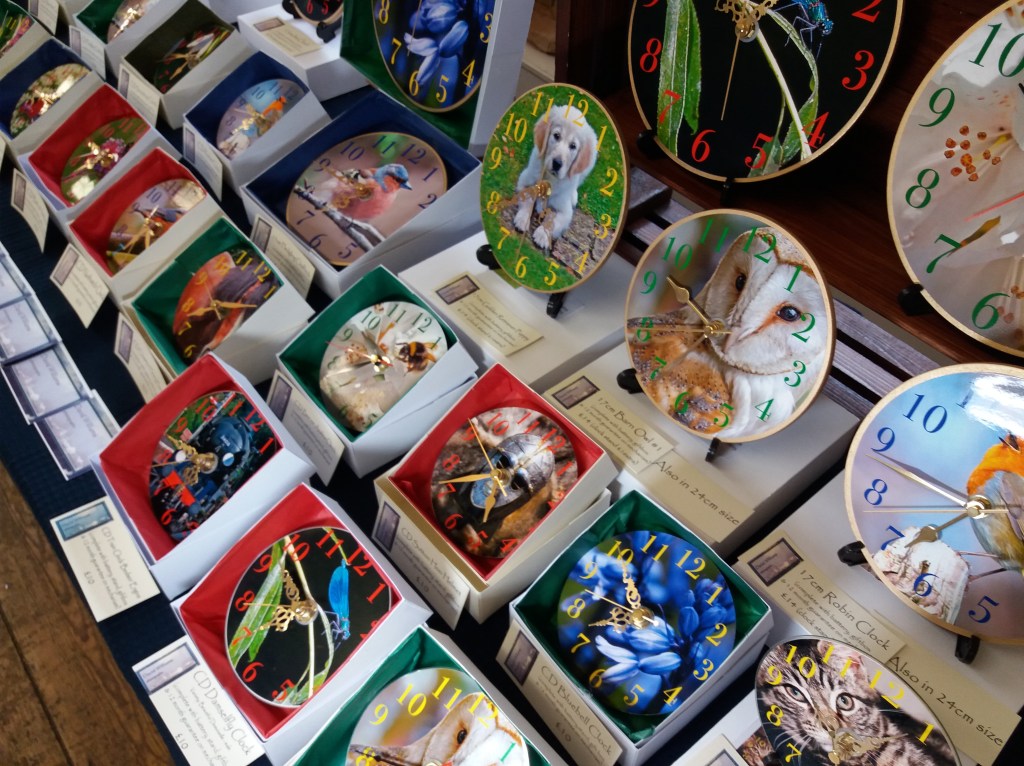
It’s a bumper issue which looks forward to what is going on this autumn. We start with a quiet morning for Creationtide at St John’s on September 2nd when Craig Nobbs will be leading us in reflecting about our care for God’s earth (see page 13). We will look at generosity and gratitude on two Sundays – September 10th and 17th (page 22) – and this month we start a series on exploring prayer, beginning on 20th when we go into Farnham Park to encounter God in nature (also page 22). Then there is our September craft market at St Mark’s on September 16th (page 48); Apple Day and Harvest Festival on 24th (page 12); and the Harvest Supper at St George’s on 29th (page 16).

It’s not all just about what’s on – among the articles you will find ones on home groups, autism, diversity, ordinations, why we hire out our halls, dog training and more, plus we are delighted to have the Badshot Leader right at the heart of the magazine, with information on The Kiln, the Community Garden and Aldershot Model Car Club.

All this plus local businesses who do so much to support our magazine by placing advertisements in it. Please do use their services.

Happy reading!

Support for autistic people

A report on a talk by Alexis Quinn

How can we best support neurodivergent people, especially those with autism?

This was the challenge which author, speaker and campaigner Alexis Quinn took on in a talk at St Mark’s in July.

It is a challenge she takes on every day as an autistic person and the mother of two neurodivergent children and her talk was the product of lived experience and the latest research in the field of autism and support for autistic people.

At the moment support for autistic people is patchy if not entirely lacking in some areas.

Alexis looked at research into both children and adults with autism and the findings are alarming.

Children

Autism is the most common type of special educational need in schools, with the latest figures indicating that there are 182,493 autistic pupils in schools in England, the majority of them (73 per cent) in mainstream schools.

Teachers are therefore highly likely to have come across at least one autistic child but according to the National Autistic Society (NAS), only 14 per cent  of secondary school teachers have had more than half a day of autism training, and without appropriate teacher training, autistic children are twice as likely to be excluded from school. In fact, 74 per cent of parents said that their child’s school place did not meet that child’s needs and 54 per cent of children found that their teachers’ failure to understand them was the worst thing about school. And yet the Equality Act 2010 means that schools have a legal duty to make reasonable adjustments to things like the school environment and policies.

Adults

It doesn’t get better for adults. The disability employment gap (the difference between how many disabled people are in work compared to how many non-disabled people are in work) is wide, with around half of disabled people in work, compared with more than 80 per cent of non-disabled people. But the autism employment gap is even wider, with just 22 per cent of autistic people reported to be in paid work. There isn’t much opportunity for independence either with three-quarters of autistic people living with their parents, compared with 16 per cent of disabled people generally (ONS, 2021).

What is autism?

The NAS defines autism as “a lifelong developmental disability which affects how people communicate and interact with the world”. All people are different but generally, autistic people have difficulties interpreting verbal and non-verbal language like gestures or tone of voice, and they often have difficulty recognising or understanding other people’s feelings and intentions, and expressing their own emotions. This can make it very hard to navigate the social world. Alexis stressed that “when we take care of communication life is made a lot easier”.  For more details see box on page 19.

Autism and society

Alexis emphasised that autism is not an illness and does not need to be treated. It is simply a difference, part of normal human variation. However, this is not how society generally sees autism, and many people try to hide their autism by ‘masking’, suppressing behaviours which they may find soothing and mimicking others in order to fit in.

This seems to be especially the case for girls, but whatever gender, this is not healthy. Many autistic people feel the stigmatised and isolated, ‘othered’ by society and then they end up in what Alexis calls a ‘cycle of disconnection’. The results are alarming: 90 per cent of autistic people meet the clinical diagnostic criteria for anxiety and depression, and bullying and victimization leads to 61 per cent meeting the diagnostic criteria for PTSD. They are nine times more likely to die by suicide than neurotypical people and the average life expectancy for a ‘high-functioning’ autistic person is only 54. For a ‘low-functioning’ person that already low figure plumets to under 40.

Crisis

Why is this? Alexis herself masked and coped until a crisis point and this is common with autistic people. When crisis comes it can be impossible to mask or meet the demands of the environment. She had been a successful teacher and an international swimmer but once she needed help she ended up in a mental health and treatment unit. She describes her experiences in her book Unbroken, a terrifying description of a mental health system itself in crisis with little understanding of autism. What she thought was going to be a 72-hour rest turned into three and a half years in hospital, where she experienced sensory overload, restraint and seclusion until she took matters into her own hands and escaped to Africa. The book is an extraordinary and powerful read.

How to make a difference

Alexis now campaigns for better treatment for those with autism and challenges the way neurodivergent people are treated. She encourages people to think carefully about language which she describes as  “one of the most subtle but common forms of ableism…The language choices we make when talking about neurodiverse people can either maintain or challenge ableism.” Examples are: rather than saying someone is ‘suffering from autism’, we could talk about the ‘impact’ or ‘effect’ of autism, and rather than asking an autistic person “Why can’t you just…?”, we could ask “What can I do to support you?”.

These differences may seem slight but the cumulative effect of subtle hurts in language and the way people are treated can lead to increased marginalisation, bullying, poor mental health and trauma.

She is keen to encourage strategies to improve awareness of autism among non-autistic people which will not only improve the experience of autistic people but will also help lay the groundwork for a more accepting society.

Immediate steps

There are also lots of immediate steps that can be taken, especially in educational settings, including exit passes to leave classrooms if overwhelmed, quiet spaces to allow recuperation, uniform adjustments to reduce sensory discomfort and adjustments to classroom lighting and seating plans. These can go some way to reducing anxiety. Alexis explained that “when anxious the thinking brain — our executive functioning skills — can go offline and our emotional brain kicks in. We cannot pay attention, provide answers to a question, even speak, sit still or remain calm.”

She also outlined the importance of helping autistic children to report bullying and how schools can make this easier by, for instance, allowing autistic pupils to say what is happening by email or drawing, as communicating may be difficult.

Empathy works both ways

Finally Alexis pointed out that the burden of communication is usually put on autisic people. Both autistic and non-autistic people have difficulty understanding and ‘feeling’ each other because of their differing outlooks and experiences with the world but “empathy is a bidirectional phenomenon”, ie, it works both ways. Why is it that autistic people, the minority neurotype, are expected to do most of the adjusting? What can non-autistic people do to acknowledge and meet an autistic person’s desire for connection? Surely we can all develop new ways of relating?

What next?

There was time for questions after the talk with many people speaking from the lived experience of either being autistic or having autistic family and friends and there was a huge desire to carry on discussing ways of supporting each other. We are compiling a list of people who would like to be involved in some way and if you would like your name and contact details added, or to find out about other support or talks in the future, email revd.stella@badshotleaandhale.org

For more about Alexis click here.

Unbroken, learning to live beyond diagnosis by Alexis Quinn is published by Trigger Publishing.

Pride

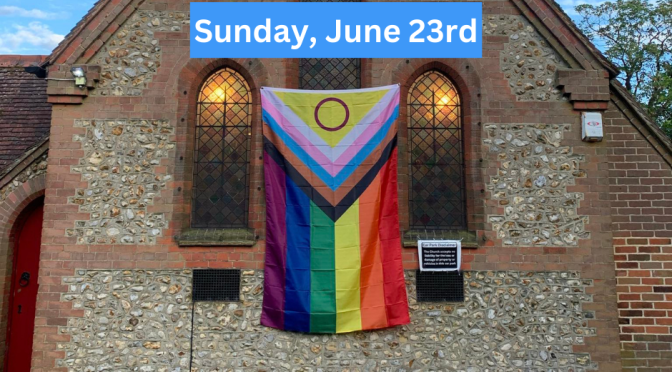
We will be celebrating Pride on June 23rd at all three of our churches and online, with special services, prayers and readings in support of and celebrating the LGBTQI+ community.

We are sometimes asked why we hold these services. Pride services are an opportunity to celebrate LGBTQI+ people in their fullness, to look back on strides toward equality, and to imagine a world where celebration and full inclusion is the norm, not an exception. 

The Christian response to LGBTQI+ people has not generally been one of welcome and the Church as a whole has not felt like a safe space for many people. In fact, Christians have used the Bible as a weapon and the church has contributed to the political, relational and spiritual dehumanizing of LGBTQI+ people.

Our support for Pride is not just a way of saying sorry for the Church’s harmful actions – some of which have led to the death of some of God’s beloved children – but also an opportunity to denounce oppressive practices and ideology while also becoming more fully human ourselves. For when we dehumanise others we reduce our own humanity.

In these services we repent of the past and we look with hope to the future. We stand with people who identify as LGBTQI+ and proclaim loudly that all people are loved by God and all people are welcome here. God is Love and we are all fearfully and wonderfully made.

Young people and faith – an interfaith discussion

The next meeting of the Women’s Interfaith Group will be at St Mark’s Church on Saturday, July 22, 2.30-4pm. This month we will be discussing how we talk to young people about faith and values. Food will be served by the women of the Ahmadiyya Muslim Women’s Association.

For further information, contact Stella Wiseman.

Dance on your Doorstep with Matthew Bourne’s New Adventures

On Saturday, July 15th, at 11am, Doorstep Duets is coming to Hale Rec in support of the churches.

Three dancers from Matthew Bourne’s New Adventures, based at Farnham Maltings, will perform Back to Us. Choreographed by Glenn Graham, Back to Us is a short, original dance piece exploring the importance of friendship and the need for connection.

The dance will take place outside Southernhay, The Green, Hale, where there will also be a coffee morning in support of the parish.

Messy Church is back!

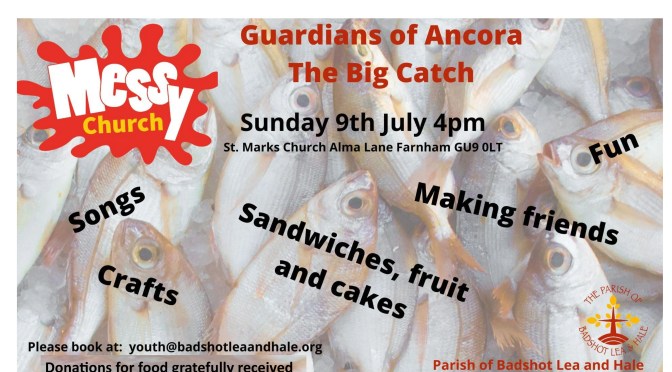
Messy Church returns this Sunday – July 9th – at 4pm at St Mark’s. This month we are exploring The Big Catch and taking a look at the computer game Guardians of Ancora.

Come along and enjoy craft, songs, games, stories, sandwiches and cakes!

Messy Church is a form of church for children and adults which involves creativity, celebration and hospitality. It typically includes a welcome, a long creative time to explore the biblical theme through getting messy; a short celebration time involving story, prayer, song, games and similar; and a sit-down meal together at tables. All elements are for people of all ages, adults and children.

To find out more contact Michelle Chapman.

Your joint July/August Magazine is here

Our summer holidays parish magazine is here, covering the months of July and August.

With summer here there is plenty going on both inside and out, and among the events featured in this issue are a free Barn Dance at St Mark’s on the evening of July 14th to celebrate the 140th birthday of the church (see page 26) and a performance of Doorstep Duets by Matthew Bourne’s New Adventures in support of a coffee morning for the parish on July 15th (see page 14).

There is also news of a talk on July 21st about how to support people with autism (page 36), family events run by Farnham Maltings at the churches (page 14), events at the Hale Family Centre (page 24), the return of Messy Church on July 9th and Pride services on August 20th (both on page 23).

Among the other articles and notices is a report on our fantastic fete (page 8) and the Christian Aid concert (page 12), plus Craig’s relicensing (page 11) and the Badshot Leader is back again (from page 19) with information on local developments, the environment, the Badshot Bloomers and a fascinating history of Walter Tice.

To read it, click here:

St Mark’s 140th Birthday Barn Dance – Friday, 14th

Join us at St Mark’s, Upper Hale, on the evening of Friday, July 14th, for a barn dance to celebrate the 140th birthday of the church. The doors will open at 6.30pm and the music will start at around 7pm.

Admission is free (donations welcome) and please bring your own refreshments, though tea, coffee, squash and cake will be on sale.

St Mark’s was opened in July 1883 as the daughter church of St John’s in Hale, to enable the residents of Upper Hale to get to church as many of them struggled to get down to St John’s. It was built by local residents using flint from the Common on land given by Bishop Sumner, Bishop of Winchester.

The church, now a Grade II listed building, is home to the Kitty Milroy murals, now recognised as key in the development of mural art in the 20th century, and the work of an unsung major talent. The murals were restored in 2021 and were shortlisted for a Surrey Heritage Award. It also houses ‘Emily‘, a fine Edwardian pipe organ.

St Mark’s is a working church and services are held every Sunday at 11am and Wednesday at 12noon.

Coffee Artz at St Mark’s

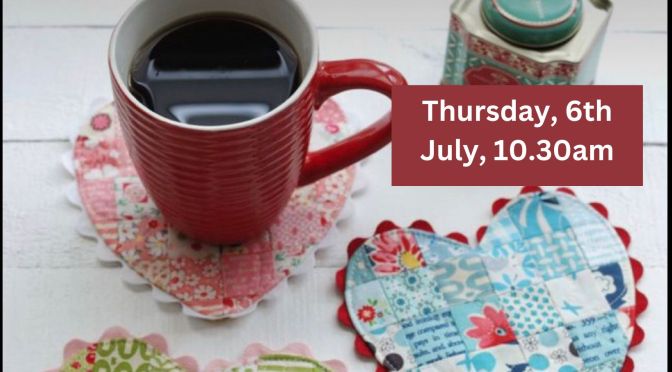
It’s Coffee Artz again this week, on Thursday, June 15th10.30am to 12noon at St Mark’s Church.

Coffee Artz takes place on the first and third Thursday of each month and each time the group takes a different theme to inspire the art. No artistic skill is needed, no experience is needed and the equipment is all provided. Coffee, chat and cake are also provided!

To find out more email Elaine Fell.

Picture by Steve Johnson on Pexels.