Category Archives: St Mark’s Church

Kitty Milroy has been commemorated with a plaque in Farnham

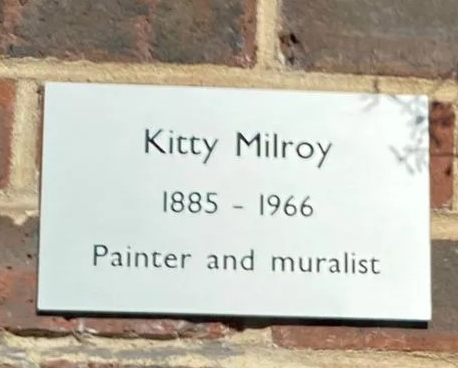
Kitty Milroy, the artist responsible for the murals in St Mark’s Church, has been commemorated with a plaque on the ‘Famous Names of Farnham’ wall in Farnham’s town centre.

The plaque was unveiled on September 21st by Cllr Alan Earwaker, Mayor of Farnham; Nick Seversway, who led the work in organising the restoration of the murals and who is an expert on Kitty Milroy; and Rev’d Lesley Crawley.

The plaque now takes its place on Farnham’s ‘wall of fame’, in South Street, celebrating local luminaries, including writer and politician William Cobbett, racing driver Mike Hawthorn and cricketer Graham Thorpe.

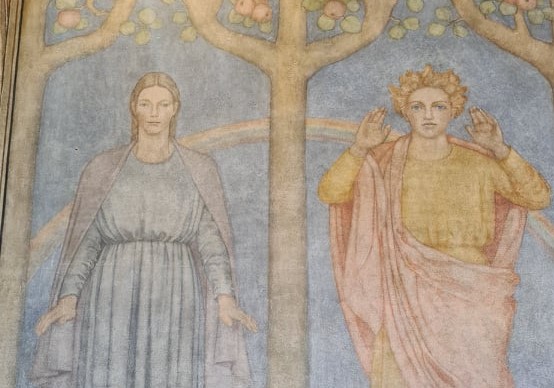
Kitty Milroy (pictured below) was born Eleanor Catherine Milroy in 1885 in Newnham, Hampshire, but lived almost all her life in the Farnham area. From 1906 onwards, she enrolled in the Slade School of Art — a renowned centre for innovation in mural art — which had recently opened its doors to female students, and between 1911 and 1920 she created the murals in St Mark’s. between 1911 and 1920. They represent local scenes and Biblical passages and the figures in them were modelled by locals at the time. In 2021 they were restored by conservators Rickerby and Shekede.

Further information is available here.

Pictured clockwise from top left: Kitty Milroy; members of the parish Arts and Crafts committee at the unveiling – from left: Chriss Green, Nick Seversway, Bob Shatwell, Jean Sanders, Lesley Crawley and Alan Crawley; Kitty’s plaque; apple tree from Kitty’s murals; figures from Kitty’s murals.

Pictured top: the unveiling of the plaque.

Bring your pets to church!

If you go down to church this Sunday (October 1st), be prepared for a surprise. Along with the singing there will be barking, maybe a little squawking and squeaking, and even some slithering when we hold a pet service at each of the churches.

Pets of all shapes and sizes will be welcomed to St John’s at 9.30am, St George’s at 10am and St Mark’s at 11am, for a service to celebrate our pets and ask for God’s blessing on them. Anyone who doesn’t want to bring their pet but still wants to celebrate them and have them blessed is encouraged to bring a photo of the pet. Children are welcome to bring toy pets and come dressed as animals too.

We are holding the service on the first Sunday of October as it is close to the feast day of St Francis of Assisi which is on October 4th. St Francis was known for his love of and care for animals and is often depicted with them. Our pets bring us great joy and are part of God’s creation so we want to celebrate them and give thanks for everything they give us. For many people having a pet is an enormous comfort and can help our mental health by reducing stress and anxiety. They can also be great companions especially to people who are on their own.

The services will be chaotic and great fun, so please come along! However, there will also be an earlier communion service at St George’s at 9am for people who prefer their worship without animal accompaniment!

Exploring Prayer

Join us for a series on different types of prayer on Wednesday evenings at St Mark’s, Upper Hale, at 7.30pm.

Over the next five weeks we will be exploring prayer in the following ways:

September 27th – The Power of Music – led by Lesley Shatwell (see picture below)

October 4th – Centering Prayer – led by Margaret Bowers

October 11th – Labyrinth – led by Michelle Chapman

October 18th – Mindfulness – led by Suzette Jones

October 25th – Daily Prayer – led by Lesley Crawley

All welcome. Contact Rev’d Stella Wiseman for further details.

Come and join the Harvest celebrations

On September 24th, celebrate the good gifts of the earth at our Harvest Festival services, held at all three churches. You can then also join us at the Harvest Supper, held at St George’s on the evening of September 29th.

There have long been celebrations around the time that crops are harvested each year, but the harvest festival that we know today probably dates from Victorian days. The first one is said have been the brainchild of the Rev’d Robert Hawker, priest of a church at Morwenstow in Cornwall, who in 1843 invited people to a thanksgiving service for the harvest.

The modern harvest festival is a time to give thanks to God for the gifts the earth provides and it is also an opportunity to share food, particularly with people who do not have enough. That is why the parish collects tinned and dried food for Farnham’s Foodbank.

The services will be at 9.30am at St John’s, Hale, 10am at St George’s, Badshot Lea, and at 10am at St Marks, Upper Hale, where we will first celebrate Apple Day with apple-y music, apple snacks and apple pressing. The harvest service will be at 11am at St Mark’s.

The Foodbank is currently in need of tinned fruit, UHT puddings, tinned meat and chocolate treats and these can be offered at the altar during the service and will then be passed on to the Foodbank.

Harvest Supper

On September 29th we will celebrate again with a Harvest Supper at St George’s from 6pm. It’s a fun evening for the whole parish with a meal, entertainment and a raffle. Tickets are available at each of the churches; Adults £10, children (under 16) £5, or by calling 07842761919 or emailing news@badshotleaandhale.org. If you can offer to be part of the entertainment, please let Kris know: warden.stgeorges@badshotleaandhale.org.

Entertainment time at last year’s Harvest Supper.

Pictured top – Harvest by Erik-Jan Leusink on Unsplash

Hiring out our churches – why we do it

Lesley Crawley explains.

I recently heard a talk by the Reverend Sam Wells, Vicar of St Martin-in-the-Fields, and he talked in a very practical way about funding church ministry. There have been various models over the centuries:

The Benefactor – often the Lord of the Manor would upkeep the church and pay for all that was needed. Very handy if you can find yourself a benefactor, but on the other hand perhaps one person could have too much sway – I guess everything, including the vicar’s sermons might have to please the benefactor.

Stewardship – the way that free churches have always organised themselves. If there are 10 people in a church and they give 10 percent of their gross income then they can afford a minister. That is fine for a house church where people meet in houses, but to get a building then a few more people need to give 10 per cent of their gross income! Anglican churches encourage Stewardship too, but rarely can people afford to give quite as much as that, or perhaps there is a different culture around giving amongst Anglicans – the Church of England recommends five per cent of our gross income.

Again, it is very handy to fund the church this way, but perhaps there is an issue that it only involves the church congregation. After all, as Anglicans, everyone in the village is part of the church. Everyone has access to the church building for services – baptisms, weddings and funerals, and for prayer; everyone is part of the ‘cure of souls’ that the vicar promises to look after. Perhaps, therefore, everyone in the village can have a hand in funding the local church. Stewardship alone might be rather inward-looking.

Social enterprise – this involves the community. It can be aspirational, for instance employing only the homeless, but at the heart of every social enterprise is the need to make money. Churches do various things – run preschools, offer themselves as concert venues, sell merchandise, and run cafés. In our case, we hire our churches out as venues for parties, meetings and clubs. Social Enterprise makes the church a seven days a week building, increases by a factor of 10 how many people come through the doors, and brings us into conversation with a huge range of people.

Who are we in conversation and partnership with? Well, lots of people, we can’t list them all but here are some examples:

We have particularly strong links with the Ahmadiyya Muslim Association and now have an interfaith women’s group with them. Stella has been asked to speak at their Itfars (the fast-breaking evening meal which Muslims have during Ramadan) and they are keen to help where they can with community initiatives, eg the Warm Hub. They have joined in our flower festivals, craft markets and the poetry festival. We get a lot of bookings from them at both St Mark’s and St George’s.

The Syro-Malabar Church hire St George’s every week to teach Kerala dancing and took part in our concert for Christian Aid.

Magikats teach students at St George’s every Tuesday and kindly donated £100 for Father Christmas presents at the craft market.

Florescence is a small floristry business at St Mark’s and has sponsored the flower festival.

Alder Valley Brass Band have hired St John’s and St Mark’s and have played at some of our events.

The Badshot Lea Ladies Group brings people from the village into St George’s who might not otherwise feel part of the church.

Baby Ballet have been regular hirers at St George’s for several years and have danced at our parish fete.

Honryu Martial Arts has just started hiring St Mark’s and the leader is keen to help support the church’s work with young people (he’s a counsellor and uses martial arts to support people with behavioural problems).

Luke from Guildford Tai Chi, who books St Mark’s on a Wednesday, took part in the embodied worship series, giving us a free session.

Stella has worked with Right at Home on some memory workshops at their Sunflower Café (for people with dementia) and they have booked St Mark’s and St George’s for various activities. We have a great relationship with them and look forward to more partnership working.

Several groups have donated raffle prizes.

The relationship with the Badshot Lea Working Men’s Club (WMC)is now excellent and we help each other out with parking. They often pay to use our car park. There is a group of older people (mostly in their 80s+) who meet at the club who are very grateful for the car park. Several of them came to the Jubilee tea party last year. Stella has been asked to baptise the son of one of the women who works at the WMC.

In addition to all this, I strongly believe that God gives us everything we need. For years we scratched our heads, wondering how to pay our way, and thanks to God’s mercy, our buildings, members of our congregation within them and Stella running our Social Enterprise, we now can pay our way. We need to do ministry and fund ministry. Hiring our buildings is a mixture of both.

More than anything, our community must experience the church as a blessing. Our hospitality is a reflection of the hospitality of the God we serve. Not long ago, Stella received this email:

I wanted to extend my sincerest gratitude for providing your hall as the venue for my baby’s first birthday party. The event was a great success, and we couldn’t have asked for a better place to celebrate this special day.

Your hall’s facilities and ambience were perfect for the occasion, and our guests thoroughly enjoyed themselves. Your assistance and support throughout the process made the planning much easier, and I truly appreciate your kind cooperation.

Once again, thank you for making my baby’s first birthday party memorable. We are grateful for your generosity and hospitality.

The community are blessing us through this ministry; not just with their money, but with their gifts such as music and dancing, allowing us to share in their ministries and their communities, giving to us out of their expertise. Hopefully, we can offer more than our space; we offer our hospitality, and our faith. For everyone in our villages, we have space that can honour you for us, every relationship is a taste of Christ.

Rev’d Lesley Crawley

Pictured top is St Mark’s Church set up for a party
How craft and coffee created a carpet

Thanks to a huge effort. a lot of generous people and extremely hard work by Bob Shatwell, St Mark’s has a new carpet (pictured above with members of the St Mark’s congregation).

The majority of the funds raised was from the Craft Market which runs at St Mark’s on the third Saturday of March, June, September and November (the next one is on 16th so come and see the carpet as well as all the crafts!). Since the market started in 2021, it has raised £3,852.50 from craft stalls and £2,005.57 from selling refreshments, in large part thanks to Jean Sanders, Chriss Green, Elaine Fell and the team, along with musicians Bob and Lesley Shatwell, Roger Sanders and friends who keep everyone entertained during the market.

Well done to everyone involved and a massive thank you! The carpet enhances the building and sets off the Kitty Milroy murals nicely.

The carpet replaces an aisle carpet which became a trip hazard and had to be taken up, and one in the nave in front of the altar which was threadbare and dirty. The new one not only looks hugely better but feels it too, so much so that one of the church’s regular hirers who runs music classes for pre-school children said: “It’s so comfortable to sit on we nearly fell asleep on it!”

From left: Elaine Fell, Rev’d Lesley Crawley, Jean Sanders on the new carpet.

Come to the autumn craft market

It’s our autumn Craft Market on Saturday, September 16th at St Mark’s Church, Upper Hale, from 10am to 2pm.

Come and browse and buy lovely homemade gifts, meet your friends in the café for coffee, cakes, and filled rolls, listen to love music, and know you are supporting local businesses and the church.

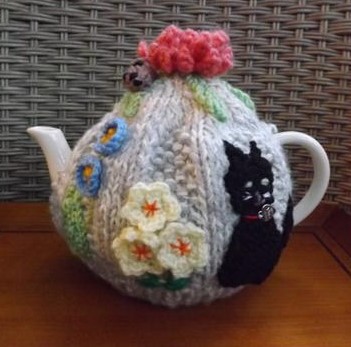
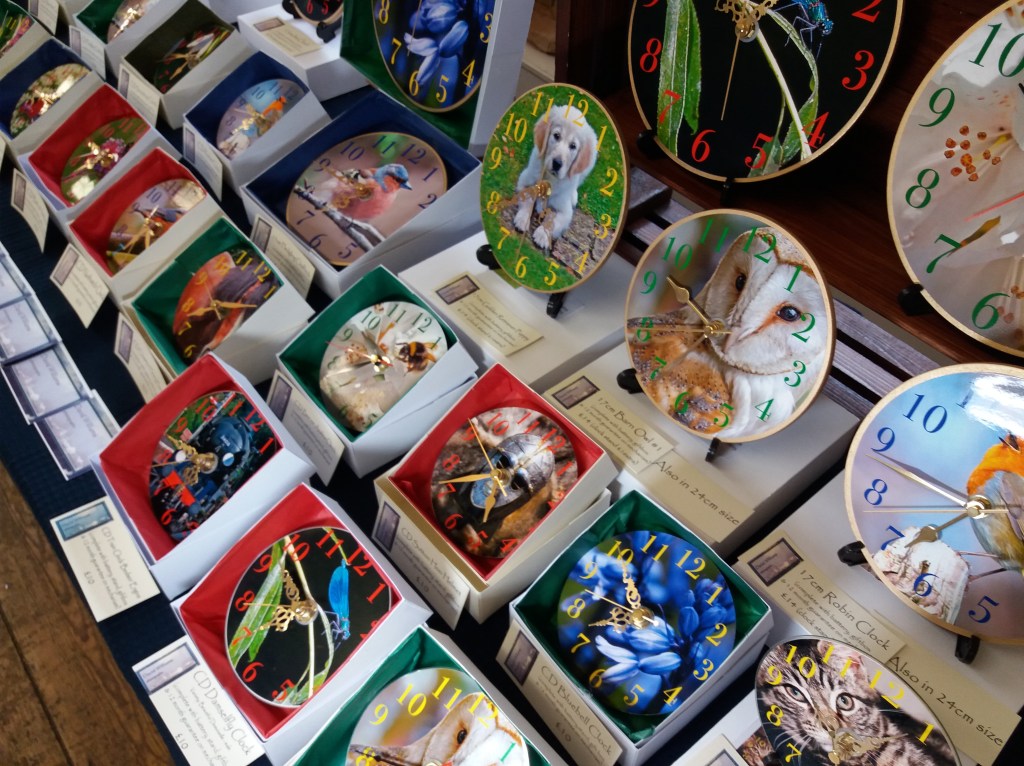
Among the stalls will be Whimsy and Joyful selling plastic-free handmade knitted Alice bands from 100% wool; clocks created from CDs by DNWFoto; Linda’s Crafting Creations selling upcycled gifts; cards from Julie Owen; Knitty Nora’s handknits; and pretty bracelets from Charlotte Barnard.

Come and have a relaxing couple of hours. You could even shop early for Christmas!

Clockwise from top left: bracelets by Charlotte Barnard, Alice bands from Whimsy and Joyful, tea cosy by Knitty Nora and clocks by DMWFoto.

Your September Magazine is here

The September issue of the parish magazine is out now and you can download it below.

It’s a bumper issue which looks forward to what is going on this autumn. We start with a quiet morning for Creationtide at St John’s on September 2nd when Craig Nobbs will be leading us in reflecting about our care for God’s earth (see page 13). We will look at generosity and gratitude on two Sundays – September 10th and 17th (page 22) – and this month we start a series on exploring prayer, beginning on 20th when we go into Farnham Park to encounter God in nature (also page 22). Then there is our September craft market at St Mark’s on September 16th (page 48); Apple Day and Harvest Festival on 24th (page 12); and the Harvest Supper at St George’s on 29th (page 16).

It’s not all just about what’s on – among the articles you will find ones on home groups, autism, diversity, ordinations, why we hire out our halls, dog training and more, plus we are delighted to have the Badshot Leader right at the heart of the magazine, with information on The Kiln, the Community Garden and Aldershot Model Car Club.

All this plus local businesses who do so much to support our magazine by placing advertisements in it. Please do use their services.

Happy reading!

Support for autistic people

A report on a talk by Alexis Quinn

How can we best support neurodivergent people, especially those with autism?

This was the challenge which author, speaker and campaigner Alexis Quinn took on in a talk at St Mark’s in July.

It is a challenge she takes on every day as an autistic person and the mother of two neurodivergent children and her talk was the product of lived experience and the latest research in the field of autism and support for autistic people.

At the moment support for autistic people is patchy if not entirely lacking in some areas.

Alexis looked at research into both children and adults with autism and the findings are alarming.

Children

Autism is the most common type of special educational need in schools, with the latest figures indicating that there are 182,493 autistic pupils in schools in England, the majority of them (73 per cent) in mainstream schools.

Teachers are therefore highly likely to have come across at least one autistic child but according to the National Autistic Society (NAS), only 14 per cent  of secondary school teachers have had more than half a day of autism training, and without appropriate teacher training, autistic children are twice as likely to be excluded from school. In fact, 74 per cent of parents said that their child’s school place did not meet that child’s needs and 54 per cent of children found that their teachers’ failure to understand them was the worst thing about school. And yet the Equality Act 2010 means that schools have a legal duty to make reasonable adjustments to things like the school environment and policies.

Adults

It doesn’t get better for adults. The disability employment gap (the difference between how many disabled people are in work compared to how many non-disabled people are in work) is wide, with around half of disabled people in work, compared with more than 80 per cent of non-disabled people. But the autism employment gap is even wider, with just 22 per cent of autistic people reported to be in paid work. There isn’t much opportunity for independence either with three-quarters of autistic people living with their parents, compared with 16 per cent of disabled people generally (ONS, 2021).

What is autism?

The NAS defines autism as “a lifelong developmental disability which affects how people communicate and interact with the world”. All people are different but generally, autistic people have difficulties interpreting verbal and non-verbal language like gestures or tone of voice, and they often have difficulty recognising or understanding other people’s feelings and intentions, and expressing their own emotions. This can make it very hard to navigate the social world. Alexis stressed that “when we take care of communication life is made a lot easier”.  For more details see box on page 19.

Autism and society

Alexis emphasised that autism is not an illness and does not need to be treated. It is simply a difference, part of normal human variation. However, this is not how society generally sees autism, and many people try to hide their autism by ‘masking’, suppressing behaviours which they may find soothing and mimicking others in order to fit in.

This seems to be especially the case for girls, but whatever gender, this is not healthy. Many autistic people feel the stigmatised and isolated, ‘othered’ by society and then they end up in what Alexis calls a ‘cycle of disconnection’. The results are alarming: 90 per cent of autistic people meet the clinical diagnostic criteria for anxiety and depression, and bullying and victimization leads to 61 per cent meeting the diagnostic criteria for PTSD. They are nine times more likely to die by suicide than neurotypical people and the average life expectancy for a ‘high-functioning’ autistic person is only 54. For a ‘low-functioning’ person that already low figure plumets to under 40.

Crisis

Why is this? Alexis herself masked and coped until a crisis point and this is common with autistic people. When crisis comes it can be impossible to mask or meet the demands of the environment. She had been a successful teacher and an international swimmer but once she needed help she ended up in a mental health and treatment unit. She describes her experiences in her book Unbroken, a terrifying description of a mental health system itself in crisis with little understanding of autism. What she thought was going to be a 72-hour rest turned into three and a half years in hospital, where she experienced sensory overload, restraint and seclusion until she took matters into her own hands and escaped to Africa. The book is an extraordinary and powerful read.

How to make a difference

Alexis now campaigns for better treatment for those with autism and challenges the way neurodivergent people are treated. She encourages people to think carefully about language which she describes as  “one of the most subtle but common forms of ableism…The language choices we make when talking about neurodiverse people can either maintain or challenge ableism.” Examples are: rather than saying someone is ‘suffering from autism’, we could talk about the ‘impact’ or ‘effect’ of autism, and rather than asking an autistic person “Why can’t you just…?”, we could ask “What can I do to support you?”.

These differences may seem slight but the cumulative effect of subtle hurts in language and the way people are treated can lead to increased marginalisation, bullying, poor mental health and trauma.

She is keen to encourage strategies to improve awareness of autism among non-autistic people which will not only improve the experience of autistic people but will also help lay the groundwork for a more accepting society.

Immediate steps

There are also lots of immediate steps that can be taken, especially in educational settings, including exit passes to leave classrooms if overwhelmed, quiet spaces to allow recuperation, uniform adjustments to reduce sensory discomfort and adjustments to classroom lighting and seating plans. These can go some way to reducing anxiety. Alexis explained that “when anxious the thinking brain — our executive functioning skills — can go offline and our emotional brain kicks in. We cannot pay attention, provide answers to a question, even speak, sit still or remain calm.”

She also outlined the importance of helping autistic children to report bullying and how schools can make this easier by, for instance, allowing autistic pupils to say what is happening by email or drawing, as communicating may be difficult.

Empathy works both ways

Finally Alexis pointed out that the burden of communication is usually put on autisic people. Both autistic and non-autistic people have difficulty understanding and ‘feeling’ each other because of their differing outlooks and experiences with the world but “empathy is a bidirectional phenomenon”, ie, it works both ways. Why is it that autistic people, the minority neurotype, are expected to do most of the adjusting? What can non-autistic people do to acknowledge and meet an autistic person’s desire for connection? Surely we can all develop new ways of relating?

What next?

There was time for questions after the talk with many people speaking from the lived experience of either being autistic or having autistic family and friends and there was a huge desire to carry on discussing ways of supporting each other. We are compiling a list of people who would like to be involved in some way and if you would like your name and contact details added, or to find out about other support or talks in the future, email revd.stella@badshotleaandhale.org

For more about Alexis click here.

Unbroken, learning to live beyond diagnosis by Alexis Quinn is published by Trigger Publishing.

Pride

We will be celebrating Pride on June 23rd at all three of our churches and online, with special services, prayers and readings in support of and celebrating the LGBTQI+ community.

We are sometimes asked why we hold these services. Pride services are an opportunity to celebrate LGBTQI+ people in their fullness, to look back on strides toward equality, and to imagine a world where celebration and full inclusion is the norm, not an exception. 

The Christian response to LGBTQI+ people has not generally been one of welcome and the Church as a whole has not felt like a safe space for many people. In fact, Christians have used the Bible as a weapon and the church has contributed to the political, relational and spiritual dehumanizing of LGBTQI+ people.

Our support for Pride is not just a way of saying sorry for the Church’s harmful actions – some of which have led to the death of some of God’s beloved children – but also an opportunity to denounce oppressive practices and ideology while also becoming more fully human ourselves. For when we dehumanise others we reduce our own humanity.

In these services we repent of the past and we look with hope to the future. We stand with people who identify as LGBTQI+ and proclaim loudly that all people are loved by God and all people are welcome here. God is Love and we are all fearfully and wonderfully made.