Category Archives: St Mark’s Church

Caravan, The Hungry Years and all that jazz

An evening of jazz in memory of Farnham journalists Jean and Ted Parratt

There will be an evening of jazz at St Mark’s Church, Hale, on Saturday, May 4 in memory of Jean and Ted Parratt, local journalists and parents of Wendy Edwards, a licensed lay reader in the parish.

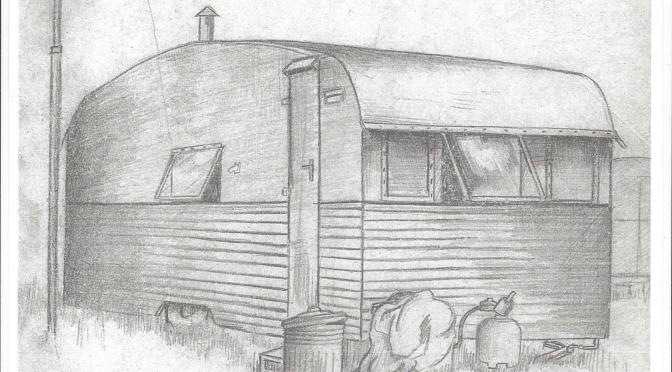
‘Caravan Jazz on a May Evening’, which will begin at 7.30pm, will feature songs by Django Reinhardt, Nat ‘King’ Cole, Ella Fitzgerald, Glenn Miller and others, and will recall the time that Ted and Jean and their young children would enjoy jazz songs in the caravan which was their home in Lincolnshire. Ted drew the picture of their first caravan – reproduced above – just before Wendy’s birth.

From her birth in October 1957 to the age of four, Wendy and her brother and sister, Mark and Debbie, lived with Jean and Ted in various sized caravans as the family grew.

By day, Ted was doing his National Service in the RAF, but in the evenings back in the caravan with Jean and the children, he played jazz on his guitar, sometimes accompanied by his best friend, Terry Blackwell. On other nights, Jean’s walnut-cased radiogram would be tuned in, often to a jazz station.

Wendy has been researching her parents’ early life and recalls that her mother: “cared wonderfully well for us through the changing seasons, making potato soup with very few potatoes (we were very challenged financially) but always ensuring we were well fed and well loved. My mother enjoyed the jazz too in the evenings and ‘made do and mended’ the family’s clothes, while jazz melodies and rhythms lullabied us children to sleep.”

Jean and Ted worked for many years as journalists and photographers on first the Surrey & Hants News and then The Farnham Diary, with Ted also working for the Farnham Herald, and Jean busy writing local history books and giving talks, particularly inspiring many young people to discover more about the past. Jean died in 2016 and Ted in 2018.

On May 4, as well as the jazz, Wendy will share some of her knowledge and photographs of the early years. She says: “My mother called that time The Hungry Years, but they both believed these were the happiest in their 60-year-long marriage.”

Joining Wendy on the evening will be Frances Whewell on keyboard and Teddy’s Café Bar Jazzmen and other talented vocalists.  A light supper is included but bring your own drinks.

Admission is free but all donations are welcome for the Kitty Milroy Murals Fund at St. Mark’s Church. However, Wendy adds: “If, like Jean and Ted in The Hungry Years, you cannot afford to donate anything, please do join us anyway as all are very welcome indeed!”

To book your place, call Wendy Edwards on 07740 082460.


Repent and flourish

A couple of Sundays ago, Lesley Shatwell preached at St Mark’s on repentance and what it means.

The  Gospel reading that day was from Luke, chapter 13, v 1-9. You can read the whole extract here but, basically, Jesus says: “unless you repent, you will all perish”. He then told the parable of the barren fig tree which was given a reprieve.

This is what Lesley had to say about this uncompromising message:

When I first read the reading, I couldn’t quite make sense of what was happening.  I had to read through a few times.  It starts when Jesus has been told about an atrocity which Pilate has committed.  He slaughtered some Jews when they were offering sacrifices to God.  My goodness, that has strong resonance for us today doesn’t it?  Muslims being gunned down when they were at prayer in New Zealand.  Perhaps Jesus overheard people trying to make their own kind of sense to a barbaric act because he tells us that those who died were no more sinners than anyone else.  They weren’t slaughtered because of their sin.

But then there’s his comment, “unless you repent, you will all perish as they did”.  That’s worrying, it doesn’t seem to make sense does it?  And it’s frightening.  On the one hand, people died in a horrible atrocity and they no more deserved it than anyone else does.  They were just in the wrong place at the wrong time.  But on the other hand, that could be our fate unless we repent.  Can repentance really ensure that we will avoid perishing, even in random acts of terror?

Same goes for the disaster when the tower of Siloam collapsed and killed 18 people.  A “natural” disaster, no one’s deliberate fault.  And “unless you repent, you will all perish as they did”.  Those people who died weren’t extra wicked sinners, they were just like you and me.  Oh Jesus, help me, I don’t even know how to repent?  What is repentance?

OK, time out!  Let’s press the pause button before we all disappear into the fiery furnaces of hell.

What does “perish” mean?  That’s straightforward at least, isn’t it?  It means “die”.  We are human, we do all die eventually.  We don’t know when, but it comes to all of us.  Some might have an untimely death, some may slip away peacefully after a long and happy life.  So I don’t think Jesus is saying, “repent and you will have a human life here on earth for ever”.  There’s something else going on.  Hum.  One of the reasons why people were flocking to be baptised by John the Baptist was because they thought the end of the world was imminent.  And tomorrow could be the last day.  It tends to focus the mind: better get ready quick before it’s too late.

But equally, who knows exactly what Jesus meant?  He might have been talking about perishing to this world so that we might rise to glory in the next.  I’m afraid you will have to consider that for yourselves because we could be here till Christmas with this sermon if I start tackling the idea of everlasting life with God in heaven.

Right, I’m ready to press the “play” button again.  Repent!  Repent!  Yes all right!

Repent or else fire and brimstone, perishing in eternal hell.  Yes, but how?

What is repentance?

Repentance is the translation of the Greek word “metanoia”, which means “a change of mind”.

Oh, so it’s that easy?  I just have to change my mind?  It can’t be so hard – particularly if I will avoid eternal damnation.  But you have to mean it.

Change your mind and do something to show that you have truly changed your mind.

Change your mind and turn to Jesus – now there’s an invitation.  Yes, an invitation, not a threat.  Change your mind and turn to Jesus.

What if all those things which have been holding me back, all those things which stop me from being truly me, all those things which I am ashamed of in my life, which worry me, which upset me … what if all that rubbish in my life perished?

Now: imagine, for a moment, you are living a reasonably contented life.  Things are ok, you get by most days.  There are some good things, maybe a lot of bad things.  But generally you find life is worth living.  It’s like you are a tree, growing in a vineyard.  Some days it’s quite pleasant, the sun shines, the birds sing.  And nobody bothers you.  Nobody asks anything of you.  You are just a tree after all and there are plenty of trees around in the world aren’t there.  Yes, there are days when the storms come and you are buffeted by wind and rain, but nobody pays much attention to you.

And then, out of the blue one day, the owner of the vineyard comes by.  Where are the figs?

Figs?  Who said anything about figs?  I didn’t know I was meant to be giving you figs.  I’m just a tree, leave me alone.  Don’t chop me down, that’s not fair.  Look, give me a chance – now I know I could give you figs, I will, but I can’t make them overnight.  I will give you the figs, especially if I get help from the gardener.

It’s one view of the parable.  Do you see what Jesus is offering us?  Repentance.  It’s not a threat, it’s an opportunity, an invitation to try something in a different way.  Of course, it could be tough, even if it’s in your nature to produce fruit, you will have to put some effort in.

But, what is it about your life that you would change?  Do you have any regrets?  Any sadness?  Any cherished hopes?  Within each one of us there is potential.  The potential to bear good fruit.  But we need the right encouragement and we need to want to unlock the potential.  Within each one of us there is something, a gift, and it would be a huge loss if we let it perish.  Maybe you have found the gift, the potential within you, maybe you are still searching.  But we do have the gardener on our side.  Jesus is ready to give us all the love and nurture we need to flourish and bear good fruit.

Repent!  Turn to those true things which bring life in all its goodness.  But be kind to yourself, all things in their own time.  Gently does it, fruit takes a while to ripen.  And remember, Jesus, the gardener is always ready to nurture and care for you.

The motherliness of God

Sunday, March 31 is Mothering Sunday, and in our services that day we will celebrate mothers and others who care for us, with posies for everyone.

Mothering Sunday is thought to have begun in the 16th century when, on the fourth Sunday of Lent, people would return to their ‘mother church’ – that is, the local parish church or the church in which they had been baptised, or the nearest cathedral. The practice also began of allowing servants to return to their families on that day so seeing their mothers as well as their mother church.

Lesley Crawley comments: “On Mothering Sunday we celebrate mothers and those who care for us, remembering and praying for our own mothers. We also know that this day can be a difficult one for those who have lost their mothers, for those who have lost or cannot have children, and for those who have not had a good relationship with their mothers, and we offer them our support and prayers too.

“God is usually referred to as ‘father’ – in part a reflection of the time and patriarchal culture in which the Bible was written – but there are certainly references to the ‘motherliness’ of God in the Bible, such as this one in the Book of Isaiah: ‘As a mother comforts her child, so I will comfort you’. Christians believe in an all-loving God who loves us even more than a human mother could. Please do join us on March 31 at any of our services and celebrate and receive this love.”

Click here for some practical ideas from the Church of England for celebrating Mothering Sunday.

The altar frontal at Chelmsford Cathedral made by Creators (Cathedral School youth group). Picture by fourthandfifteen (www.flickr.com/photos/chelmsfordblue/)


Where is God in the storm?

The Gospel reading on February 24 was from Luke 8, 22-25. At St Mark’s that day, Lesley Shatwell preached.

The Gospel passage:

‘One day he got into a boat with his disciples, and he said to them, “Let us go across to the other side of the lake.” So they put out, and while they were sailing he fell asleep. A windstorm swept down on the lake, and the boat was filling with water, and they were in danger. They went to him and woke him up, shouting, “Master, Master, we are perishing!” And he woke up and rebuked the wind and the raging waves; they ceased, and there was a calm. He said to them, “Where is your faith?” They were afraid and amazed, and said to one another, “Who then is this, that he commands even the winds and the water, and they obey him?”’

Lesley’s sermon:

Jesus said to them: “Where is your faith?”

That’s a good question. And what is faith anyway?

It’s easy to believe something if you can see it to be true. The disciples witnessed how Jesus was able to calm the storm, so they came to believe.

But is that the same as faith? I don’t think it is.

Faith is about knowing. But it’s about truly knowing something even though you can’t explain it to anyone else. It’s not something we can measure. “I wish I had your faith … etc”

It’s not something we can force in ourselves and it is something which we can lose just at that very moment when it could be useful.

Just at that moment when you are all at sea in a storm.

Loss of faith doesn’t have to be so dramatic though.

The theologian Thomas Merton talks eloquently about how people can lose faith very easily. In summary he says: ‘People seem to lose their faith as they grow more mature. To start with, it’s easy, believe this and you do. But then the comfortable reassurance you get stops working. And then, well well, God’s not looking after me, why should I have faith in him? What’s God ever done for me? I don’t believe he exists, he’s never around when I need him.’

Merton goes on to say: ‘Don’t put faith in “sunshine” Christians, who promise a quick fix. You may have to find God alone. Faith is personal, nobody else can do it for you.’

I think a lot of us are looking for a quick fix. Something which will make us feel safe and secure, loved and well cared for.

And perhaps it seems that God offers this. All will be well, if I just had a bit more faith in God … and perhaps it would, I’m certainly not going to dismiss people’s faith, but at the risk of being less than a “sunshine” Christian, I can’t offer it to you that today. That’s a quick fix.

It doesn’t take into account that plain fact that none of us can force ourselves to believe in God.

I can look with wonder and a fair dollop of jealousy at people whose faith can move mountains, and yes, I probably envy them, but it is not my experience of being Christian. There are some days when I wake up and I know, without a shadow of a doubt that Jesus is my saviour. That wonderful aria from Messiah, “I know that my redeemer liveth …” is playing like a constant companion in my mind and the joy of the Holy Spirit runs right through me.

Then I catch a glimpse of the outrider clouds of a massive storm and all those wretched doubts creep in.

Life is tough. Lots of people have things far more tough in life than I do, but, dear Lord, this is me and there are times it feels as though I am totally alone and lost in a storm at sea. I long for Jesus to wake up and make everything better for me. But it hasn’t happened yet.

But before I wallow too much in the awfulness of everything, I must be honest: there are good times along with the bad times.

There are times when I love my life, I’m full of delight with everything and everyone around me. Times when life can get no better. And then it is tempting to think, “Oh, this is all down to me, to my careful planning, everything is working out well and I’m in charge.”

Wrong! God’s in charge.

It’s God’s doing, even though it may seem as though God is asleep and letting me get on with my life, I have to acknowledge that my joy is not entirely down to me.

God has given me a wonderful day and it is at times like that when I sometimes remember to give thanks and show my gratitude.

Often I don’t, because I’m human and I accept the good times which come to me as though I have a right to them.

It’s different though when things go wrong. Have you ever had days when you wake up with a feeling of dread as to what is going to happen now you have come out of the dreamland? Have you ever had days when everything hurts, everyone you meet seems to rub you up the wrong way so it would have been better if you had avoided people?

Yes, people, they are the problem; no, it’s my tummy, I shouldn’t have eaten that great big dinner last night; oh my back aches; no, it’s that awful meeting I’m going to have with my boss – yes, I knew it, everybody else is the problem. Always someone else’s fault.

Probably God’s fault. Everybody else is happy and well and I’m not.

God this isn’t fair, why have you forsaken me?

What have I done wrong? Wake up God!

It’s true, isn’t it?

We call on God a great deal more to sort out our problems than we do to give thanks and praise. It’s when disasters happen that we wonder where God is and why he has abandoned us.

Where was God during the tsunami? Where was God when evil people get into power? Why didn’t God stop that child from being hurt? Yes, God – where are you? Why are you asleep in the back of our boat as we are sailing head-on into a storm?

Wake up Jesus! We need you here now.

In our reading today, we hear about experienced fishermen who made their living going out in boats.

And they were terrified, they thought they were going to die. They were out of their depth as the gale swept down on them and the waters poured into their boat. All their own effort and skill couldn’t save them.

All the while, there is one person, their friend who sleeps through it all. He is with them though. He’s not left them. He’s in the boat with them.

At the point in the gospel where this passage occurs, they are just learning who Jesus is. They need more reassurance before their faith is strong enough to realise that because Jesus is with them in the boat, whatever happens, they are safe in the loving care of God.

The winds and waters obey Jesus, for God created all things. By calming the storm and saving their physical lives, Jesus is not forcing them to have faith, he is showing them again that he is with them.

In our lives there are plenty of storms when it seems that God is asleep and not aware of our troubles. Despite what it feels like, that’s not so, for God is always with us – as the final words Jesus says according to the Gospel of Matthew: “And remember, I am with you always, to the end of the age”.

Perhaps he is asleep but I don’t happen to think so. And anyway, what I do know is that Jesus is most definitely in the boat with us.


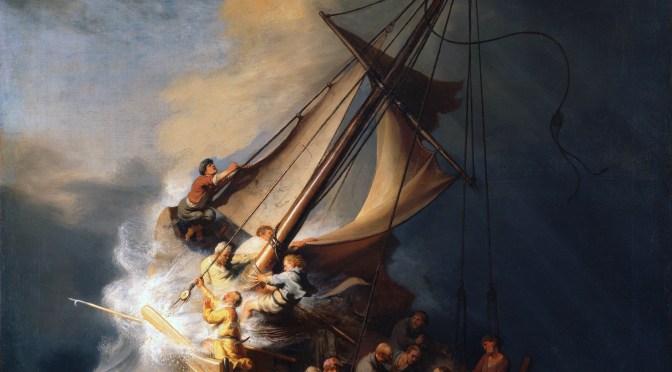
Picture: Christ in the Storm on the Lake of Galilee by Rembrandt.
A comforting croodle

The Celtic musical tradition of the British Isles is a rich one, with music which has been passed down the generations in Wales, Scotland, Ireland and the North East of England, and which has permeated non-Celtic culture. After all, don’t we all sing Auld Lang Syne at new year?

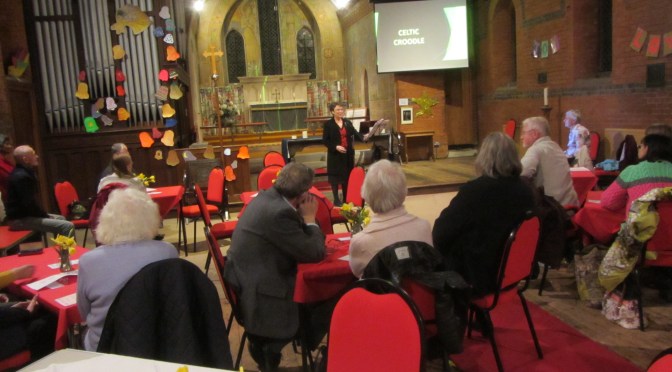
Auld Lang Syne is not the only familiar Celtic tune – there are plenty which most of us can sing along to, something ably demonstrated by the Celtic Croodle which took part at St Mark’s Church last Saturday evening (February 9), thanks to the hard work and talent of Wendy Edwards with support from Frances Whewell.

To croodle means to snuggle together and St Mark’s looked cosy and warm, offering welcome after a wet February day.  We sat around tables while Wendy, accompanied on the piano by Frances, led us on a musical tour of the Celtic parts of the British Isles, encouraging us to join in.

We started and ended in Scotland and en route we learned a little of the background to each song, though sometimes the origins are obscure. So we learned, for instance that the ‘low road’ in Loch Lomon (“O ye’ll tak’ the high road, and I’ll tak’ the low road, And I’ll be in Scotland a’fore ye,”) may refer to the tradition that the soul of a dead Scot who died abroad was taken back to rest in Scotland by a secret road; and that Bobby Shafto (a north-eastern song) was an 18th century politician who may well have dandled a baby or two in the hope of improving his reputation (“Bobby Shafto’s gettin’ a bairn/For to dangle on his arm”).

On the trip through Ireland among those we learned and sang about were young Mollie Malone, and an Irish émigré shocked by the fashions and attitudes of 19th-century London, writing back to his true love in a valley near the Mountains of Mourne. In Wales as well as singing along lustily to Land of My Fathers (and not a rugby ball in sight), we listened to Wendy sing beautiful songs including David of the White Rock and we were moved by All through the Night, before hurrying back to Scotland to join hands and sing Auld Lang Syne.

As well as the music, Wendy had provided a light Celtic supper of oatcakes, cheese, cheese and onion ‘sausages’, shortbread and Welsh cakes, which we enjoyed at the interval.

It was a happy, comforting and relaxing evening, an antidote to the February blues that can strike us. It also raised £200 in donations for the Kitty Milroy murals appeal through which we are planning to restore the rare and important murals in the chancel at St Mark’s.

Wendy is holding another musical evening at St Mark’s in May. This one will be a jazz evening in memory of her parents, renowned local journalists and historians Jean and Ted Parratt. It will take place at the church on May 4 from 7.30pm.  A light meal will be included but please bring your own drinks. The evening will also raise money for the Kitty Milroy murals,

A Celtic Croodle

Everyone is invited to an old-fashioned Celtic singalong at St Mark’s on February 9 from 7.30pm.

The Celtic ‘Croodle’ will trace a journey in song through Scotland, the north-east of England, Ireland and Wales, led by Wendy Edwards, accompanied by Frances Whewell.

There will be a light Celtic supper (oatcakes, cheese, Welsh cakes and shortbread) – bring your own drinks.

To croodle means to snuggle together so come along to snuggle and sing with us, in aid of restoring the Kitty Milroy murals at St Mark’s. All donations gratefully received.

Poverty in plain sight

Poverty is hidden in plain sight in our community. We may live in one of the least deprived parts of the country but there are pockets of real poverty here. In 2015, for instance, Sandy Hill was the most deprived borough in Waverley, especially in measures relating to income, education/skills and health.

Across the UK as a whole, we have seen an increase in the use of food banks, homelessness and rough sleeping, slavery and mental distress. With poverty comes poverty of spirit – self-esteem, isolation, depression. So, what can we do?

On Monday, February 4, Suzette Jones (Open to All / Health and Wellbeing Adviser from the Diocese of Guildford) will be leading a session at St Mark’s, from 7.30-9pm, to discuss this. As well as looking at the issues facing our society, the session will include practical suggestions to help us stand together against poverty. We will look at ways forward both through prayer and other steps we might take.

“Suppose a brother or a sister is without clothes and daily food. If one of you says to them ‘Go in peace; keep warm and well fed,’ but does nothing about their physical needs, what good is it?” James 2:15-16 (NIV).

For further information, contact Lesely Shatwell, llm.lesley@badshotleaandhale.org


The Story that Matters Most

We are still early in the new year, still at the time when any new year’s resolutions are at least not a distant memory (the second Friday in January is said to be the one when most of us have given up on resolutions). What if one of our resolutions this year could be to follow Jesus more truly? What if we were able to respond to the question “is this the year we’ll walk in Your ways?” with a promise to do all we can?

That question is one asked in a carol which was sung at St Mark’s last month. It was in fact a world premiere of a carol by author, songworker and artist Ash Brockwell. The carol was ‘The Story that Matters Most’.

Just before we sang it, I told the congregation how I had come across it. Ash had shared it on Facebook because of his concern and compassion for a 17-year-old transgender boy, Eli, who had already attempted suicide twice, who had then been asked to leave his church. Ash asked: ‘How is it possible that we still have church leaders who can reject and hurt such a vulnerable young person and yet convince themselves they’re doing God’s work?’. I don’t know the answer to that, but the God I put my faith in is one who welcomes all and loves all and who asks us to walk in his ways and do the same. We dedicated the song to Eli and others like him.

The carol, sung to the tune of William Parry’s Jerusalem, is going to be part of our canon. The story of how Ash came to write it is recorded here.

And here are the words:

The Story that Matters Most

Two thousand years this story’s been told,
Two thousand years and still we sing:
The Magi came with spices and gold
To glorify the new-born king;
The stable bare, the angels there,
the humble shepherds gathered around…
To tell the story that mattered most,
The love and hope their hearts had found.

Two thousand years and still we’re the same,
Watching the flames of hatred burn,
The grief and fear still spread in Your name…
Beloved, will we ever learn?
I know Your only law is Love,
I’ll hold to what I know to be true,
Perhaps the story that matters most
Is one that starts with me and You?

I won’t let hatred tear me apart,
I will not yield to doubt and fear;
I’ll look within the core of my heart,
And find You always waiting here.
You know the truth of who I am:
Open my eyes and help me to see,
Until the story that matters most
Begins again with You and me.

Is this the year we’ll walk in Your ways?
Is this the year we’ll learn to lead,
And share Your truth through worship and praise,
But also thought and word and deed?
What leads to fear is never right,
what leads to Love can never be wrong;
We know the story that matters most
Is one in which we ALL belong.


Stella Wiseman


Emily and the Generations on the radio

Emily and the Generations may sound a little like a pop group, but today’s blog post title actually refers to an interview with Lesley Crawley on BBC Radio Surrey this morning (Sunday, Jan 13).

She was interviewed on the Sunday Breakfast show about our final push to raise money for Emily the organ – just £559 to go folks, come on, we can do it – but the interview spanned far more than just Emily, important and beloved as she is.

Interviewer Emily Jeffery talked to Lesley about how Emily the organ is a beloved part of the community and how her overhaul will allow us to use her again in worship, concerts and for children to learn on.

Then the interview broadened out to something that is also dear to our parish – the way we try to bring old and young and in between together.

Lesley spoke about the fact that local school children will be welcomed in to see the organ when it is being restored, how the table tennis club we run has become a ‘youth group for all ages’, the fact that we don’t send the children out of church for a separate Sunday school (“we are an inclusive church … and it seems wrong to send out part of our congregation”), the plans for opening St John’s up more to the community and bringing people together with a café, and other resources, perhaps even a nursery which could link in with a local care home.

To hear the interview click here and go to 2:38:52.


Picture by Will Francis. Unsplash.


‘Emily’ the Organ – one last push!

We are nearly there! ‘Emily,’ the pipe organ at St Mark’s Church, Upper Hale, is in need of a thorough overhaul – at 106 years old she is showing her age. We need £23,000 to mend her and we are almost there – just £559 to go!

The money has been raised by the generosity of local people, the hard work of fundraisers and those who have put on and taken part in events, as well as funds from grant-giving bodies. Some people have sponsored pipes, others have made donations at concerts, sung, produced art, recited poetry, made cakes, bought cakes, even constructed a model organ and pushed it round two carnivals! Thank you everyone for what you have done.

We are now appealing for the last little bit so that work can begin this year. One easy way is by sponsoring a pipe. Pipes can be sponsored anonymously or not, and if you sponsor a pipe you can dedicate it to a loved one. You will receive a certificate and the church will display all the names and notes that all the sponsors write on a ‘Sponsoring a Pipe’ manuscript. There will be a celebratory concert once ‘Emily’ has been restored to which all those who have sponsored a pipe will be invited.

Rev’d Lesley Crawley from St Mark’s said: “Emily is a beautiful Edwardian pipe organ which is over 100 years old. She is referred to as ‘Emily’ after her benefactor – Emily Mangles. Sadly, she has been used very rarely over the past six years because, after a century of service, she is in need of a complete overhaul. Once she is restored then she will be available for community events such as concerts, and children who are learning the organ will be able to practise on her once again.”

These are the recommended donations:

Choose your level            Donation

Stop                                           £100

16ft pipe                                   £60

8ft pipe                                     £30

4ft pipe                                     £15

If you would like to donate, please contact Lesley on
revd.lesley@badshotleaandhale.org