All posts by Administrator

Follow the donkey to church

There will be donkeys at church this coming Sunday (April 14) in celebration of Palm Sunday.

Palm Sunday recalls the Biblical account of Jesus riding into Jerusalem on a donkey, with crowds placing palms in front of him and greeting him as a king. Churches around the world will mark the date, and at St Mark’s, Hale, at 11am, and St George’s, Badshot Lea, at 11.30am, the congregations will be joined by donkeys, courtesy of Folly Oak Donkeys.

Rev’d Lesley Crawley said: “When we recall that Jesus rode into Jerusalem on a donkey it reminds us that he is a king who comes in peace, not as a conquering warrior. Having a donkey at a service also brings the story alive, especially for children who always crowd round to give the donkey a stroke. Please do come and join us. And we are really grateful to John and Rosemary Porter and all at Folly Oak Donkeys for bringing the donkeys to us.”


Pictured: Meet the Donkey. Picture by Daniel Fazio. Unsplash

Caravan, The Hungry Years and all that jazz

An evening of jazz in memory of Farnham journalists Jean and Ted Parratt

There will be an evening of jazz at St Mark’s Church, Hale, on Saturday, May 4 in memory of Jean and Ted Parratt, local journalists and parents of Wendy Edwards, a licensed lay reader in the parish.

‘Caravan Jazz on a May Evening’, which will begin at 7.30pm, will feature songs by Django Reinhardt, Nat ‘King’ Cole, Ella Fitzgerald, Glenn Miller and others, and will recall the time that Ted and Jean and their young children would enjoy jazz songs in the caravan which was their home in Lincolnshire. Ted drew the picture of their first caravan – reproduced above – just before Wendy’s birth.

From her birth in October 1957 to the age of four, Wendy and her brother and sister, Mark and Debbie, lived with Jean and Ted in various sized caravans as the family grew.

By day, Ted was doing his National Service in the RAF, but in the evenings back in the caravan with Jean and the children, he played jazz on his guitar, sometimes accompanied by his best friend, Terry Blackwell. On other nights, Jean’s walnut-cased radiogram would be tuned in, often to a jazz station.

Wendy has been researching her parents’ early life and recalls that her mother: “cared wonderfully well for us through the changing seasons, making potato soup with very few potatoes (we were very challenged financially) but always ensuring we were well fed and well loved. My mother enjoyed the jazz too in the evenings and ‘made do and mended’ the family’s clothes, while jazz melodies and rhythms lullabied us children to sleep.”

Jean and Ted worked for many years as journalists and photographers on first the Surrey & Hants News and then The Farnham Diary, with Ted also working for the Farnham Herald, and Jean busy writing local history books and giving talks, particularly inspiring many young people to discover more about the past. Jean died in 2016 and Ted in 2018.

On May 4, as well as the jazz, Wendy will share some of her knowledge and photographs of the early years. She says: “My mother called that time The Hungry Years, but they both believed these were the happiest in their 60-year-long marriage.”

Joining Wendy on the evening will be Frances Whewell on keyboard and Teddy’s Café Bar Jazzmen and other talented vocalists.  A light supper is included but bring your own drinks.

Admission is free but all donations are welcome for the Kitty Milroy Murals Fund at St. Mark’s Church. However, Wendy adds: “If, like Jean and Ted in The Hungry Years, you cannot afford to donate anything, please do join us anyway as all are very welcome indeed!”

To book your place, call Wendy Edwards on 07740 082460.


Repent and flourish

A couple of Sundays ago, Lesley Shatwell preached at St Mark’s on repentance and what it means.

The  Gospel reading that day was from Luke, chapter 13, v 1-9. You can read the whole extract here but, basically, Jesus says: “unless you repent, you will all perish”. He then told the parable of the barren fig tree which was given a reprieve.

This is what Lesley had to say about this uncompromising message:

When I first read the reading, I couldn’t quite make sense of what was happening.  I had to read through a few times.  It starts when Jesus has been told about an atrocity which Pilate has committed.  He slaughtered some Jews when they were offering sacrifices to God.  My goodness, that has strong resonance for us today doesn’t it?  Muslims being gunned down when they were at prayer in New Zealand.  Perhaps Jesus overheard people trying to make their own kind of sense to a barbaric act because he tells us that those who died were no more sinners than anyone else.  They weren’t slaughtered because of their sin.

But then there’s his comment, “unless you repent, you will all perish as they did”.  That’s worrying, it doesn’t seem to make sense does it?  And it’s frightening.  On the one hand, people died in a horrible atrocity and they no more deserved it than anyone else does.  They were just in the wrong place at the wrong time.  But on the other hand, that could be our fate unless we repent.  Can repentance really ensure that we will avoid perishing, even in random acts of terror?

Same goes for the disaster when the tower of Siloam collapsed and killed 18 people.  A “natural” disaster, no one’s deliberate fault.  And “unless you repent, you will all perish as they did”.  Those people who died weren’t extra wicked sinners, they were just like you and me.  Oh Jesus, help me, I don’t even know how to repent?  What is repentance?

OK, time out!  Let’s press the pause button before we all disappear into the fiery furnaces of hell.

What does “perish” mean?  That’s straightforward at least, isn’t it?  It means “die”.  We are human, we do all die eventually.  We don’t know when, but it comes to all of us.  Some might have an untimely death, some may slip away peacefully after a long and happy life.  So I don’t think Jesus is saying, “repent and you will have a human life here on earth for ever”.  There’s something else going on.  Hum.  One of the reasons why people were flocking to be baptised by John the Baptist was because they thought the end of the world was imminent.  And tomorrow could be the last day.  It tends to focus the mind: better get ready quick before it’s too late.

But equally, who knows exactly what Jesus meant?  He might have been talking about perishing to this world so that we might rise to glory in the next.  I’m afraid you will have to consider that for yourselves because we could be here till Christmas with this sermon if I start tackling the idea of everlasting life with God in heaven.

Right, I’m ready to press the “play” button again.  Repent!  Repent!  Yes all right!

Repent or else fire and brimstone, perishing in eternal hell.  Yes, but how?

What is repentance?

Repentance is the translation of the Greek word “metanoia”, which means “a change of mind”.

Oh, so it’s that easy?  I just have to change my mind?  It can’t be so hard – particularly if I will avoid eternal damnation.  But you have to mean it.

Change your mind and do something to show that you have truly changed your mind.

Change your mind and turn to Jesus – now there’s an invitation.  Yes, an invitation, not a threat.  Change your mind and turn to Jesus.

What if all those things which have been holding me back, all those things which stop me from being truly me, all those things which I am ashamed of in my life, which worry me, which upset me … what if all that rubbish in my life perished?

Now: imagine, for a moment, you are living a reasonably contented life.  Things are ok, you get by most days.  There are some good things, maybe a lot of bad things.  But generally you find life is worth living.  It’s like you are a tree, growing in a vineyard.  Some days it’s quite pleasant, the sun shines, the birds sing.  And nobody bothers you.  Nobody asks anything of you.  You are just a tree after all and there are plenty of trees around in the world aren’t there.  Yes, there are days when the storms come and you are buffeted by wind and rain, but nobody pays much attention to you.

And then, out of the blue one day, the owner of the vineyard comes by.  Where are the figs?

Figs?  Who said anything about figs?  I didn’t know I was meant to be giving you figs.  I’m just a tree, leave me alone.  Don’t chop me down, that’s not fair.  Look, give me a chance – now I know I could give you figs, I will, but I can’t make them overnight.  I will give you the figs, especially if I get help from the gardener.

It’s one view of the parable.  Do you see what Jesus is offering us?  Repentance.  It’s not a threat, it’s an opportunity, an invitation to try something in a different way.  Of course, it could be tough, even if it’s in your nature to produce fruit, you will have to put some effort in.

But, what is it about your life that you would change?  Do you have any regrets?  Any sadness?  Any cherished hopes?  Within each one of us there is potential.  The potential to bear good fruit.  But we need the right encouragement and we need to want to unlock the potential.  Within each one of us there is something, a gift, and it would be a huge loss if we let it perish.  Maybe you have found the gift, the potential within you, maybe you are still searching.  But we do have the gardener on our side.  Jesus is ready to give us all the love and nurture we need to flourish and bear good fruit.

Repent!  Turn to those true things which bring life in all its goodness.  But be kind to yourself, all things in their own time.  Gently does it, fruit takes a while to ripen.  And remember, Jesus, the gardener is always ready to nurture and care for you.

When inclusion means we have to change

Inclusion is a journey. Inclusion is not easy. Inclusion is worth it.

These are three conclusions I reached at the end of a weekend conference called ‘Being an Inclusive Faith Community’ at the beginning of the month.

It was a challenging and moving weekend at which a small group of us gathered in the warm and welcoming atmosphere of Woodbrooke Quaker Centre in Birmingham. I was the only non-Quaker in the group, which was led by Mark Russ, tutor at Woodbrooke, and Ruth Wilde, national co-ordinator of Inclusive Church, an organisation to which this parish belongs.

One of the first lessons of inclusion in a faith context is that the light of God shines in everyone, and we had this written up in the room in which we met, alongside other guidelines drawn from Quakerism including the belief in true equality and that Quakers seek to follow ‘the right way, not the popular way’.

These tenets are key. We probably think we are all lovely and welcoming and never exclude anyone, but when we take a deeper look we can discover that not everyone is as included as we might think. Changing that is an ongoing process and can meet opposition, not least in ourselves. For if we genuinely welcome everyone in, we will welcome in those we don’t understand, those we don’t like, those we don’t approve of, those who challenge us. Heck, we might even have to change.

There are several exercises I would like to try out in the parish following on from the weekend. One of them is to make us look at our own privilege and how we unconsciously or otherwise make it harder for others to feel truly accepted and valued. Are there people in our churches who feel they have little to give because of their background, illness or disability? Are there people who are not listened to because they find it hard to express ideas or because no-one thinks to ask them? Are there people who do not come into church because they believe they would not be welcome and if so, what have we done to make them feel like that? What barriers are we putting up?

I think that listening to each other’s stories and our true, lived experiences is key here, and not just listening but acting on what we learn. So if someone says that they feel left out or unwelcome, ask why and genuinely listen. If someone says they are afraid of something, or overwhelmed by it – too much noise perhaps – what can be done which also allows other people to express themselves? We are not looking to become some lowest common denominator which seeks to please everyone and ends up pleasing no-one, we are looking to become a radically welcoming community where everyone’s gifts and voices are heard.

It’s not easy and we will get it wrong time and again. There were times even in a group committed to inclusion, as we were that weekend, when we found it hard to understand each other. Sometimes it can be too hard. Sometimes genuine listening and being prepared to accept that we have to change is a step too far. It is possible to exclude ourselves.

I think there is a good example of this in the story of the prodigal son (Luke 15: 11-32) which ends with the younger son, who has previously rejected his father and the life he lived with him, coming back and being welcomed by his father with open arms and a party. This understandably upsets the older son who refuses to join in because he has dutifully stood by his father, worked hard and as he says, never been given so much as a young goat to kill so that he can celebrate with his friends. The father replies “Son, you are always with me, and all that is mine is yours. But we had to celebrate and rejoice, because this brother of yours was dead and has come to life; he was lost and has been found.”

I hope that at this point the elder son came in to the party, welcomed his brother back and maybe found ways of getting along with him, even learning from him. We believe we have a God who is worth sharing so we must share and celebrate with everyone, and we must be prepared to change in following the radical welcoming God who will never give up on any of us.


Picture by Rémi Walle. Unsplash.


The motherliness of God

Sunday, March 31 is Mothering Sunday, and in our services that day we will celebrate mothers and others who care for us, with posies for everyone.

Mothering Sunday is thought to have begun in the 16th century when, on the fourth Sunday of Lent, people would return to their ‘mother church’ – that is, the local parish church or the church in which they had been baptised, or the nearest cathedral. The practice also began of allowing servants to return to their families on that day so seeing their mothers as well as their mother church.

Lesley Crawley comments: “On Mothering Sunday we celebrate mothers and those who care for us, remembering and praying for our own mothers. We also know that this day can be a difficult one for those who have lost their mothers, for those who have lost or cannot have children, and for those who have not had a good relationship with their mothers, and we offer them our support and prayers too.

“God is usually referred to as ‘father’ – in part a reflection of the time and patriarchal culture in which the Bible was written – but there are certainly references to the ‘motherliness’ of God in the Bible, such as this one in the Book of Isaiah: ‘As a mother comforts her child, so I will comfort you’. Christians believe in an all-loving God who loves us even more than a human mother could. Please do join us on March 31 at any of our services and celebrate and receive this love.”

Click here for some practical ideas from the Church of England for celebrating Mothering Sunday.

The altar frontal at Chelmsford Cathedral made by Creators (Cathedral School youth group). Picture by fourthandfifteen (www.flickr.com/photos/chelmsfordblue/)


Car inventor’s grave restored at St John’s

One of the most famous graves in the churchyard at St John’s – that belonging to the motor vehicle inventor John Henry Knight – has been restored.

The grave dates from 1917 and had fallen into disrepair so we sought and received the go-ahead from John Knight’s descendants to repair the monument.

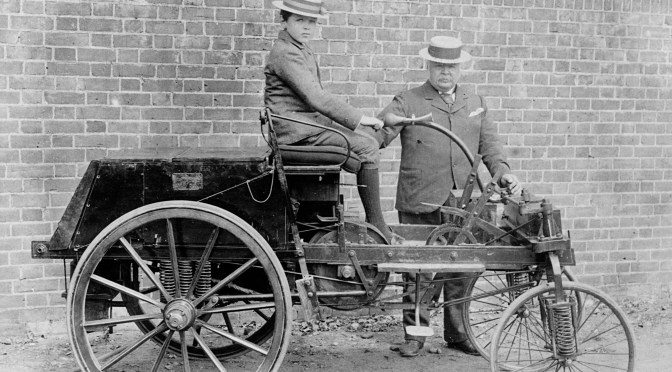
John Henry Knight, who was born in 1847 and lived in Weybourne House, Weybourne Road, invented one of Britain’s earliest petrol-powered motor vehicles. In October 1895 he also went down in history as one of the first recipients of a motoring fine when he and his assistant James Pullinger were found guilty at ‘Farnham Petty Sessions’ in Farnham Town Hall of using a locomotive without a licence and of not having a red flag carried in front. James Pullinger had been stopped while driving the vehicle in Castle Street, Farnham, earlier in the month. The car can now be seen in the National Motor Museum, Beaulieu.

John Knight pleaded not guilty on the grounds that the vehicle was too light to come under the Traction Act, but he and Pullinger were both found guilty and received a fine and costs. After that, he ran the vehicle on a private road but even then was nearly caught by a policeman hiding in a hedge. John Knight stated afterwards in his Recollections that this was “probably the first police trap on record”.

John Knight was responsible for several other inventions, including a steam-powered hop-digger, a brick-laying machine, a grenade-thrower, a radiator and a ‘dish lever’ for tilting plates when carving meat. Appropriately, given his motoring brush with the law, he also invented wooden vehicle tyres and a speedometer.

John Knight had also built a steam carriage as far back as 1868 and drove it on the roads around Farnham. According to contemporary writer William Fletcher this could carry three people at up to eight miles an hour and “easily mounted the hills in the neighbourhood of Farnham”, though John Knight himself admitted that “breakdowns were frequent”.

Lesley Crawley commented: “John Henry Knight seems to have been a colourful and clever man who was always using his ingenuity to create something new and solve problems of the day. Everyone in the parish has the right to be buried in our churchyard and everyone is equally special and equally loved by God. I find it humbling to think of all the people who have been associated with the church over the past 175 years and who will be in the future. The church is for everyone from the most eccentric inventors to the quietest passers-by.”

The grave.

Weybourne House 1Weybourne House where John Henry Knight lived as a child.

Pictured top: John Henry Knight (standing) with his vehicle in 1895. Picture courtesy of the National Motor Museum, Beaulieu.

Inspiring vision and pathways to prayer

Lent is as much a time for taking up new habits as it is for giving up old ones, and one of the habits we are encouraged to develop is that of prayer.

Sometimes we need new ways into prayer and one such is being offered this Lent at St John’s on a Wednesday evening from 7.30pm – using the visual arts to provide inspiration and pathways to prayer.

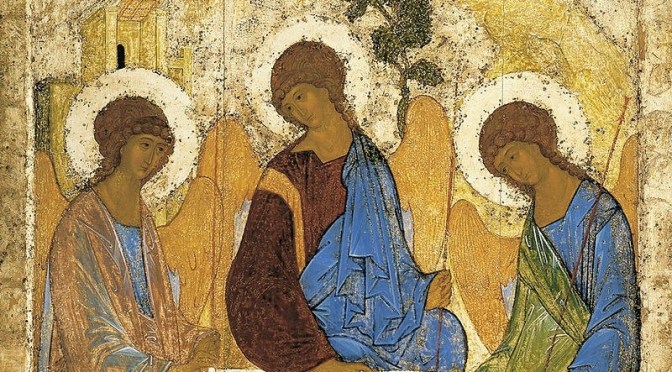
The first was Wednesday this week, when a small group considered ‘Prayer and the Trinity’, meditating on the painting Holy Trinity by Rublev, reading a passage from Paul’s letter to the Colossians (chapter 1, vs 3-14) and considering the creator, saviour and inspirer – Father, Son and Holy Spirit.

Next Wednesday, we will look at Prayer in Challenging Times and the painting The Scream by Edvard Munch, and in subsequent weeks Prayer and Discipleship, and Caravaggio’s The Call of Levi; The Joy and Excitement of Prayer with The Visitation (Mary and Elizabeth) from the Church of the Sitio, Suchitoto, El Salvador; and finally Repentance and Forgiveness with Rembrandt’s The Prodigal Son.

Come and join us and find new ways in to prayer through art.

the scream

Pictured above: The Scream by Munch

Pictured top: Holy Trinity by Rublev

An offer to everyone of healing and wholeness

There will be a service of healing and wholeness at St George’s this Sunday (March 17), at 10am, where everyone will have the chance to receive prayer and anointing with oil.

Healing and wholeness are not just about physical recovery. Lesley Crawley explains: “During his lifetime Jesus came alongside people, had compassion on them and healed them. Christians believe that in order to be whole we need to be at peace with God, with ourselves, with other people and with creation.

“Healing and wholeness can be about forgiving ourselves or forgiving others; they can be about moving from a place of denial to one of acceptance; they can be about finally finding peace of mind or finding the strength of spirit to overcome problems that have dogged us for years. Healing and wholeness are for everyone, for we worship a God of love who wants the very best for every person who God created.”

Come and join us at St George’s on Sunday at 10am.


Picture by Myriams-Fotos on Pixabay.

Where is God in the storm?

The Gospel reading on February 24 was from Luke 8, 22-25. At St Mark’s that day, Lesley Shatwell preached.

The Gospel passage:

‘One day he got into a boat with his disciples, and he said to them, “Let us go across to the other side of the lake.” So they put out, and while they were sailing he fell asleep. A windstorm swept down on the lake, and the boat was filling with water, and they were in danger. They went to him and woke him up, shouting, “Master, Master, we are perishing!” And he woke up and rebuked the wind and the raging waves; they ceased, and there was a calm. He said to them, “Where is your faith?” They were afraid and amazed, and said to one another, “Who then is this, that he commands even the winds and the water, and they obey him?”’

Lesley’s sermon:

Jesus said to them: “Where is your faith?”

That’s a good question. And what is faith anyway?

It’s easy to believe something if you can see it to be true. The disciples witnessed how Jesus was able to calm the storm, so they came to believe.

But is that the same as faith? I don’t think it is.

Faith is about knowing. But it’s about truly knowing something even though you can’t explain it to anyone else. It’s not something we can measure. “I wish I had your faith … etc”

It’s not something we can force in ourselves and it is something which we can lose just at that very moment when it could be useful.

Just at that moment when you are all at sea in a storm.

Loss of faith doesn’t have to be so dramatic though.

The theologian Thomas Merton talks eloquently about how people can lose faith very easily. In summary he says: ‘People seem to lose their faith as they grow more mature. To start with, it’s easy, believe this and you do. But then the comfortable reassurance you get stops working. And then, well well, God’s not looking after me, why should I have faith in him? What’s God ever done for me? I don’t believe he exists, he’s never around when I need him.’

Merton goes on to say: ‘Don’t put faith in “sunshine” Christians, who promise a quick fix. You may have to find God alone. Faith is personal, nobody else can do it for you.’

I think a lot of us are looking for a quick fix. Something which will make us feel safe and secure, loved and well cared for.

And perhaps it seems that God offers this. All will be well, if I just had a bit more faith in God … and perhaps it would, I’m certainly not going to dismiss people’s faith, but at the risk of being less than a “sunshine” Christian, I can’t offer it to you that today. That’s a quick fix.

It doesn’t take into account that plain fact that none of us can force ourselves to believe in God.

I can look with wonder and a fair dollop of jealousy at people whose faith can move mountains, and yes, I probably envy them, but it is not my experience of being Christian. There are some days when I wake up and I know, without a shadow of a doubt that Jesus is my saviour. That wonderful aria from Messiah, “I know that my redeemer liveth …” is playing like a constant companion in my mind and the joy of the Holy Spirit runs right through me.

Then I catch a glimpse of the outrider clouds of a massive storm and all those wretched doubts creep in.

Life is tough. Lots of people have things far more tough in life than I do, but, dear Lord, this is me and there are times it feels as though I am totally alone and lost in a storm at sea. I long for Jesus to wake up and make everything better for me. But it hasn’t happened yet.

But before I wallow too much in the awfulness of everything, I must be honest: there are good times along with the bad times.

There are times when I love my life, I’m full of delight with everything and everyone around me. Times when life can get no better. And then it is tempting to think, “Oh, this is all down to me, to my careful planning, everything is working out well and I’m in charge.”

Wrong! God’s in charge.

It’s God’s doing, even though it may seem as though God is asleep and letting me get on with my life, I have to acknowledge that my joy is not entirely down to me.

God has given me a wonderful day and it is at times like that when I sometimes remember to give thanks and show my gratitude.

Often I don’t, because I’m human and I accept the good times which come to me as though I have a right to them.

It’s different though when things go wrong. Have you ever had days when you wake up with a feeling of dread as to what is going to happen now you have come out of the dreamland? Have you ever had days when everything hurts, everyone you meet seems to rub you up the wrong way so it would have been better if you had avoided people?

Yes, people, they are the problem; no, it’s my tummy, I shouldn’t have eaten that great big dinner last night; oh my back aches; no, it’s that awful meeting I’m going to have with my boss – yes, I knew it, everybody else is the problem. Always someone else’s fault.

Probably God’s fault. Everybody else is happy and well and I’m not.

God this isn’t fair, why have you forsaken me?

What have I done wrong? Wake up God!

It’s true, isn’t it?

We call on God a great deal more to sort out our problems than we do to give thanks and praise. It’s when disasters happen that we wonder where God is and why he has abandoned us.

Where was God during the tsunami? Where was God when evil people get into power? Why didn’t God stop that child from being hurt? Yes, God – where are you? Why are you asleep in the back of our boat as we are sailing head-on into a storm?

Wake up Jesus! We need you here now.

In our reading today, we hear about experienced fishermen who made their living going out in boats.

And they were terrified, they thought they were going to die. They were out of their depth as the gale swept down on them and the waters poured into their boat. All their own effort and skill couldn’t save them.

All the while, there is one person, their friend who sleeps through it all. He is with them though. He’s not left them. He’s in the boat with them.

At the point in the gospel where this passage occurs, they are just learning who Jesus is. They need more reassurance before their faith is strong enough to realise that because Jesus is with them in the boat, whatever happens, they are safe in the loving care of God.

The winds and waters obey Jesus, for God created all things. By calming the storm and saving their physical lives, Jesus is not forcing them to have faith, he is showing them again that he is with them.

In our lives there are plenty of storms when it seems that God is asleep and not aware of our troubles. Despite what it feels like, that’s not so, for God is always with us – as the final words Jesus says according to the Gospel of Matthew: “And remember, I am with you always, to the end of the age”.

Perhaps he is asleep but I don’t happen to think so. And anyway, what I do know is that Jesus is most definitely in the boat with us.


Picture: Christ in the Storm on the Lake of Galilee by Rembrandt.

Reflections and reconciliation in Lent

On Wednesday, March 6, we begin the solemn and yet hopeful season of Lent, the 40 days which lead up to Good Friday when we commemorate Jesus’ death on the cross, and then celebrate the miracle of the Resurrection on Easter Sunday.

Lent can be an opportunity to reflect on life and faith and every year the church offers resources to encourage this. There will be Lent groups in the parish in which we will study material looking at the environment – contact Hannah for details – and a series of Lent services entitled ‘The Prophetic Voice’ will be at St. Mark’s on Fridays at noon from March 8 until April 12 with a light lunch served afterwards (if you would like to stay for lunch, please contact us by clicking here).

There are ideas too for those who prefer private study. The Bishop of Guildford’s Lent Challenge enables you to receive a daily email following a series of themes designed to encourage us to become becoming more prayerful and confident Christian disciples in daily life. There are leaflets in church and you can sign up here:

The Archbishop of Canterbury recommends a Lent book each year and this year it is Reconciliation by Muthuraj Swamy.

Reconciliation is desperately needed at the moment, both in the church and the wider world and in this book there are 40 Bible studies which teach lessons about reconciliation — its foundation, its impediments, its risks, and its heart as represented in the recurring phrase “radical openness to others”, which Swamy believes summarises “the whole essence of Christianity”.

The Church Times describes the book as requiring: “quite a lot of daily application” and as suitable for those used to serious Bible-reading. The reviewer adds: “Swamy has valuable things to say about rival groups’ claiming victimhood; the roots of prejudice and stereotyping in naming and generalisation; the need for someone to take the initiative if reconciliation is to begin; and learning to see God on the other side. But the focus of his attention is the Bible interpreted in relation to his theme.”

Another suggestion is Pilgrim Journeys: 40 Days of Reflections on the Beatitudes. This book by Steven Croft, Bishop of Oxford, is two sets of 40-day bite-size reflections: one for Lent on eight Beatitudes and the other for Easter on eight petitions in the Lord’s Prayer. Each Beatitude and petition has a five-day cycle, with a daily Bible reading, brief reflection, prayers, and a challenging outcome (during Lent) or pause (during Eastertide). The reflections are described by the Church Times as having “the air of being written by someone whose soul is soaked in the scriptures”.

May this Lent be one of reconciliation and reflection.


Picture by Toa Heftiba on Unsplash.