All posts by Administrator

The motherliness of God

Sunday, March 31 is Mothering Sunday, and in our services that day we will celebrate mothers and others who care for us, with posies for everyone.

Mothering Sunday is thought to have begun in the 16th century when, on the fourth Sunday of Lent, people would return to their ‘mother church’ – that is, the local parish church or the church in which they had been baptised, or the nearest cathedral. The practice also began of allowing servants to return to their families on that day so seeing their mothers as well as their mother church.

Lesley Crawley comments: “On Mothering Sunday we celebrate mothers and those who care for us, remembering and praying for our own mothers. We also know that this day can be a difficult one for those who have lost their mothers, for those who have lost or cannot have children, and for those who have not had a good relationship with their mothers, and we offer them our support and prayers too.

“God is usually referred to as ‘father’ – in part a reflection of the time and patriarchal culture in which the Bible was written – but there are certainly references to the ‘motherliness’ of God in the Bible, such as this one in the Book of Isaiah: ‘As a mother comforts her child, so I will comfort you’. Christians believe in an all-loving God who loves us even more than a human mother could. Please do join us on March 31 at any of our services and celebrate and receive this love.”

Click here for some practical ideas from the Church of England for celebrating Mothering Sunday.

The altar frontal at Chelmsford Cathedral made by Creators (Cathedral School youth group). Picture by fourthandfifteen (www.flickr.com/photos/chelmsfordblue/)


Car inventor’s grave restored at St John’s

One of the most famous graves in the churchyard at St John’s – that belonging to the motor vehicle inventor John Henry Knight – has been restored.

The grave dates from 1917 and had fallen into disrepair so we sought and received the go-ahead from John Knight’s descendants to repair the monument.

John Henry Knight, who was born in 1847 and lived in Weybourne House, Weybourne Road, invented one of Britain’s earliest petrol-powered motor vehicles. In October 1895 he also went down in history as one of the first recipients of a motoring fine when he and his assistant James Pullinger were found guilty at ‘Farnham Petty Sessions’ in Farnham Town Hall of using a locomotive without a licence and of not having a red flag carried in front. James Pullinger had been stopped while driving the vehicle in Castle Street, Farnham, earlier in the month. The car can now be seen in the National Motor Museum, Beaulieu.

John Knight pleaded not guilty on the grounds that the vehicle was too light to come under the Traction Act, but he and Pullinger were both found guilty and received a fine and costs. After that, he ran the vehicle on a private road but even then was nearly caught by a policeman hiding in a hedge. John Knight stated afterwards in his Recollections that this was “probably the first police trap on record”.

John Knight was responsible for several other inventions, including a steam-powered hop-digger, a brick-laying machine, a grenade-thrower, a radiator and a ‘dish lever’ for tilting plates when carving meat. Appropriately, given his motoring brush with the law, he also invented wooden vehicle tyres and a speedometer.

John Knight had also built a steam carriage as far back as 1868 and drove it on the roads around Farnham. According to contemporary writer William Fletcher this could carry three people at up to eight miles an hour and “easily mounted the hills in the neighbourhood of Farnham”, though John Knight himself admitted that “breakdowns were frequent”.

Lesley Crawley commented: “John Henry Knight seems to have been a colourful and clever man who was always using his ingenuity to create something new and solve problems of the day. Everyone in the parish has the right to be buried in our churchyard and everyone is equally special and equally loved by God. I find it humbling to think of all the people who have been associated with the church over the past 175 years and who will be in the future. The church is for everyone from the most eccentric inventors to the quietest passers-by.”

The grave.

Weybourne House 1Weybourne House where John Henry Knight lived as a child.

Pictured top: John Henry Knight (standing) with his vehicle in 1895. Picture courtesy of the National Motor Museum, Beaulieu.

Inspiring vision and pathways to prayer

Lent is as much a time for taking up new habits as it is for giving up old ones, and one of the habits we are encouraged to develop is that of prayer.

Sometimes we need new ways into prayer and one such is being offered this Lent at St John’s on a Wednesday evening from 7.30pm – using the visual arts to provide inspiration and pathways to prayer.

The first was Wednesday this week, when a small group considered ‘Prayer and the Trinity’, meditating on the painting Holy Trinity by Rublev, reading a passage from Paul’s letter to the Colossians (chapter 1, vs 3-14) and considering the creator, saviour and inspirer – Father, Son and Holy Spirit.

Next Wednesday, we will look at Prayer in Challenging Times and the painting The Scream by Edvard Munch, and in subsequent weeks Prayer and Discipleship, and Caravaggio’s The Call of Levi; The Joy and Excitement of Prayer with The Visitation (Mary and Elizabeth) from the Church of the Sitio, Suchitoto, El Salvador; and finally Repentance and Forgiveness with Rembrandt’s The Prodigal Son.

Come and join us and find new ways in to prayer through art.

the scream

Pictured above: The Scream by Munch

Pictured top: Holy Trinity by Rublev

An offer to everyone of healing and wholeness

There will be a service of healing and wholeness at St George’s this Sunday (March 17), at 10am, where everyone will have the chance to receive prayer and anointing with oil.

Healing and wholeness are not just about physical recovery. Lesley Crawley explains: “During his lifetime Jesus came alongside people, had compassion on them and healed them. Christians believe that in order to be whole we need to be at peace with God, with ourselves, with other people and with creation.

“Healing and wholeness can be about forgiving ourselves or forgiving others; they can be about moving from a place of denial to one of acceptance; they can be about finally finding peace of mind or finding the strength of spirit to overcome problems that have dogged us for years. Healing and wholeness are for everyone, for we worship a God of love who wants the very best for every person who God created.”

Come and join us at St George’s on Sunday at 10am.


Picture by Myriams-Fotos on Pixabay.

Where is God in the storm?

The Gospel reading on February 24 was from Luke 8, 22-25. At St Mark’s that day, Lesley Shatwell preached.

The Gospel passage:

‘One day he got into a boat with his disciples, and he said to them, “Let us go across to the other side of the lake.” So they put out, and while they were sailing he fell asleep. A windstorm swept down on the lake, and the boat was filling with water, and they were in danger. They went to him and woke him up, shouting, “Master, Master, we are perishing!” And he woke up and rebuked the wind and the raging waves; they ceased, and there was a calm. He said to them, “Where is your faith?” They were afraid and amazed, and said to one another, “Who then is this, that he commands even the winds and the water, and they obey him?”’

Lesley’s sermon:

Jesus said to them: “Where is your faith?”

That’s a good question. And what is faith anyway?

It’s easy to believe something if you can see it to be true. The disciples witnessed how Jesus was able to calm the storm, so they came to believe.

But is that the same as faith? I don’t think it is.

Faith is about knowing. But it’s about truly knowing something even though you can’t explain it to anyone else. It’s not something we can measure. “I wish I had your faith … etc”

It’s not something we can force in ourselves and it is something which we can lose just at that very moment when it could be useful.

Just at that moment when you are all at sea in a storm.

Loss of faith doesn’t have to be so dramatic though.

The theologian Thomas Merton talks eloquently about how people can lose faith very easily. In summary he says: ‘People seem to lose their faith as they grow more mature. To start with, it’s easy, believe this and you do. But then the comfortable reassurance you get stops working. And then, well well, God’s not looking after me, why should I have faith in him? What’s God ever done for me? I don’t believe he exists, he’s never around when I need him.’

Merton goes on to say: ‘Don’t put faith in “sunshine” Christians, who promise a quick fix. You may have to find God alone. Faith is personal, nobody else can do it for you.’

I think a lot of us are looking for a quick fix. Something which will make us feel safe and secure, loved and well cared for.

And perhaps it seems that God offers this. All will be well, if I just had a bit more faith in God … and perhaps it would, I’m certainly not going to dismiss people’s faith, but at the risk of being less than a “sunshine” Christian, I can’t offer it to you that today. That’s a quick fix.

It doesn’t take into account that plain fact that none of us can force ourselves to believe in God.

I can look with wonder and a fair dollop of jealousy at people whose faith can move mountains, and yes, I probably envy them, but it is not my experience of being Christian. There are some days when I wake up and I know, without a shadow of a doubt that Jesus is my saviour. That wonderful aria from Messiah, “I know that my redeemer liveth …” is playing like a constant companion in my mind and the joy of the Holy Spirit runs right through me.

Then I catch a glimpse of the outrider clouds of a massive storm and all those wretched doubts creep in.

Life is tough. Lots of people have things far more tough in life than I do, but, dear Lord, this is me and there are times it feels as though I am totally alone and lost in a storm at sea. I long for Jesus to wake up and make everything better for me. But it hasn’t happened yet.

But before I wallow too much in the awfulness of everything, I must be honest: there are good times along with the bad times.

There are times when I love my life, I’m full of delight with everything and everyone around me. Times when life can get no better. And then it is tempting to think, “Oh, this is all down to me, to my careful planning, everything is working out well and I’m in charge.”

Wrong! God’s in charge.

It’s God’s doing, even though it may seem as though God is asleep and letting me get on with my life, I have to acknowledge that my joy is not entirely down to me.

God has given me a wonderful day and it is at times like that when I sometimes remember to give thanks and show my gratitude.

Often I don’t, because I’m human and I accept the good times which come to me as though I have a right to them.

It’s different though when things go wrong. Have you ever had days when you wake up with a feeling of dread as to what is going to happen now you have come out of the dreamland? Have you ever had days when everything hurts, everyone you meet seems to rub you up the wrong way so it would have been better if you had avoided people?

Yes, people, they are the problem; no, it’s my tummy, I shouldn’t have eaten that great big dinner last night; oh my back aches; no, it’s that awful meeting I’m going to have with my boss – yes, I knew it, everybody else is the problem. Always someone else’s fault.

Probably God’s fault. Everybody else is happy and well and I’m not.

God this isn’t fair, why have you forsaken me?

What have I done wrong? Wake up God!

It’s true, isn’t it?

We call on God a great deal more to sort out our problems than we do to give thanks and praise. It’s when disasters happen that we wonder where God is and why he has abandoned us.

Where was God during the tsunami? Where was God when evil people get into power? Why didn’t God stop that child from being hurt? Yes, God – where are you? Why are you asleep in the back of our boat as we are sailing head-on into a storm?

Wake up Jesus! We need you here now.

In our reading today, we hear about experienced fishermen who made their living going out in boats.

And they were terrified, they thought they were going to die. They were out of their depth as the gale swept down on them and the waters poured into their boat. All their own effort and skill couldn’t save them.

All the while, there is one person, their friend who sleeps through it all. He is with them though. He’s not left them. He’s in the boat with them.

At the point in the gospel where this passage occurs, they are just learning who Jesus is. They need more reassurance before their faith is strong enough to realise that because Jesus is with them in the boat, whatever happens, they are safe in the loving care of God.

The winds and waters obey Jesus, for God created all things. By calming the storm and saving their physical lives, Jesus is not forcing them to have faith, he is showing them again that he is with them.

In our lives there are plenty of storms when it seems that God is asleep and not aware of our troubles. Despite what it feels like, that’s not so, for God is always with us – as the final words Jesus says according to the Gospel of Matthew: “And remember, I am with you always, to the end of the age”.

Perhaps he is asleep but I don’t happen to think so. And anyway, what I do know is that Jesus is most definitely in the boat with us.


Picture: Christ in the Storm on the Lake of Galilee by Rembrandt.

Reflections and reconciliation in Lent

On Wednesday, March 6, we begin the solemn and yet hopeful season of Lent, the 40 days which lead up to Good Friday when we commemorate Jesus’ death on the cross, and then celebrate the miracle of the Resurrection on Easter Sunday.

Lent can be an opportunity to reflect on life and faith and every year the church offers resources to encourage this. There will be Lent groups in the parish in which we will study material looking at the environment – contact Hannah for details – and a series of Lent services entitled ‘The Prophetic Voice’ will be at St. Mark’s on Fridays at noon from March 8 until April 12 with a light lunch served afterwards (if you would like to stay for lunch, please contact us by clicking here).

There are ideas too for those who prefer private study. The Bishop of Guildford’s Lent Challenge enables you to receive a daily email following a series of themes designed to encourage us to become becoming more prayerful and confident Christian disciples in daily life. There are leaflets in church and you can sign up here:

The Archbishop of Canterbury recommends a Lent book each year and this year it is Reconciliation by Muthuraj Swamy.

Reconciliation is desperately needed at the moment, both in the church and the wider world and in this book there are 40 Bible studies which teach lessons about reconciliation — its foundation, its impediments, its risks, and its heart as represented in the recurring phrase “radical openness to others”, which Swamy believes summarises “the whole essence of Christianity”.

The Church Times describes the book as requiring: “quite a lot of daily application” and as suitable for those used to serious Bible-reading. The reviewer adds: “Swamy has valuable things to say about rival groups’ claiming victimhood; the roots of prejudice and stereotyping in naming and generalisation; the need for someone to take the initiative if reconciliation is to begin; and learning to see God on the other side. But the focus of his attention is the Bible interpreted in relation to his theme.”

Another suggestion is Pilgrim Journeys: 40 Days of Reflections on the Beatitudes. This book by Steven Croft, Bishop of Oxford, is two sets of 40-day bite-size reflections: one for Lent on eight Beatitudes and the other for Easter on eight petitions in the Lord’s Prayer. Each Beatitude and petition has a five-day cycle, with a daily Bible reading, brief reflection, prayers, and a challenging outcome (during Lent) or pause (during Eastertide). The reflections are described by the Church Times as having “the air of being written by someone whose soul is soaked in the scriptures”.

May this Lent be one of reconciliation and reflection.


Picture by Toa Heftiba on Unsplash.

Your fete needs you!

This year’s Parish Fete will take place on June 15th and we need as many people as possible to get involved.

The fete is usually our biggest fundraiser and helps to keep us afloat, so it would be great if everyone could be thinking ‘How can I help?’.

We need people to run stalls. Last year we had a real struggle to find enough volunteers for all the stalls and some games weren’t run at all.

We need donations for the stalls – bottles, (lots of bottles – they can be soft drinks as well as alcohol), tombola prizes – little things like boxes of pencils, nice pads of paper and sweets, as well as lovely items that people will want to win. And plants, preferably labelled clearly which would really help those running the plant stall who aren’t necessarily experts!, We need items for the auction, raffle prizes, toiletries, cakes, good quality toys, books, home produce – jams, pickles and so on….. you know, you’ve done this before!

We are not having a White Elephant or Good as New this year but there are plenty of other stalls and activities which need to be run. Have you got a good idea for a new game – and are you prepared to run it?

Do you make lovely things that could go on a craft stall?

Can you sell more raffle tickets than anyone else?

Last year we raised more than £2,700 – wouldn’t it be great if we can make over £3,000? We can! We just need everyone to help.

To offer ideas and help, please contact Maxine – Maxine.everitt@live.co.uk


Church is a who, not a what

On February 17 we celebrated, for the second year in a row, Love your Church Sunday. Here is the sermon preached that day by Stella Wiseman at St John’s and St Mark’s.

We love because he first loved us

Sunday was Love your Church Sunday and given out at the services – and sent to those who weren’t there but are part of the church – were some leaflets titled Love your Church Sunday 2019.

That does rather raise the question why we might love our church.

The leaflet speaks a lot about this and about some of the ways we might respond, but I wanted to share some personal ideas about why I have moved from a position of thinking that church is something I should do and should like, to something I actually really do like, in fact I do love it, even when I don’t love the institution of the church.

I have been in the Anglican church all my life and, for many years took part in communion services where the words near the start of the Eucharistic prayer – the one that leads up to saying the Lord’s Prayer and then receiving communion – were:

Let us give thanks to the Lord our God
It is right to give him thanks and praise.

It is indeed right,
it is our duty and our joy,
at all times and in all places
to give you thanks and praise,
holy Father, heavenly King,
almighty and eternal God,
through Jesus Christ your Son our Lord.

I could always appreciate the duty bit, but not the joy. But I think that was when I saw church as something we did – a place we went to, liturgies we followed, beliefs I thought we had to have, beliefs that I had somehow to persuade myself to have even when I wasn’t sure I had them, which made it was all quite trying.

But recently it has dawned on me that church is not about what we do and what we believe so much as about who we are. Church is a who, not a what. By that I mean it’s about us being the body of Christ, all with our own strengths, weaknesses, personalities, beliefs, understanding etc, and all loved and equally important in God’s eyes, and all of us part of the body of Christ on earth.

It’s actually being here in this parish that I have begun to learn this, to learn that church is a community, a family, though with fewer blood ties. That’s what church started out like in the days after Jesus was on earth – a community – though in the early church they held all their possessions in common which I am not suggesting we do (although we are encouraged to make contributions to the church and there is more about that in the Love your Church Sunday 2019 leaftet. They were a community and we are a community.

That doesn’t mean we are all lovey-dovey and everything is sweetness and light. There are, as we all know, divisions in the church as a whole, deep divisions and deep hurt. There were divisions in the days of the early church – in particular about and between Jews and Gentiles (eg in Acts six ‘the Hellenists complained against the Hebrews because their widows were being neglected in the daily distribution of food’), and there was great division over circumcision and whether it was necessary.

There will always be divisions as, guess what, we are human and we don’t know all the answers despite what we think. But this sermon is about what we love about church not the divisions and we forget this sometimes and focus on what we do not love, on what goes wrong.

What I love is the community and support in bad times. We all have these. Many of you will be going through a very difficult time at the moment, or just coming out of one, or about to head in to one. It is what happens. My family and I have had a pretty rubbish time recently with redundancy and illness, and there has been huge support for us. This has been through the church and from elsewhere – one non-churchgoing friend turned up with a big bag of food and some flowers for us at one point. Jesus doesn’t work just through ‘churchgoers’.

But there are added dimensions that I have found in the church which are not so apparent elsewhere. The first is the understanding that God is with us in all of this. In the Old Testament reading this week (Jeremiah 17 5-10) it is written: “Blessed are those who trust in the Lord… They shall be like a tree planted by water, sending out its roots by the stream. It shall not fear when heat comes, and its leaves shall stay green; in the year of drought it is not anxious, and it does not cease to bear fruit.” I’m not saying that I am not fearing or anxious or that I am bearing a lot of fruit at the moment – I am very anxious, today has been particularly tough, and what I can do is limited – but I understand from this and from elsewhere (eg Psalm 23 ‘Yea, though I walk through the valley of the shadow of death, I will fear no evil; for you are with me; your rod and your staff, they comfort me.’) that God is with us in this.

The second is prayer. Sometimes I haven’t been able to pray. It has seemed foolish, as if somehow I am expecting a miracle. In times of crisis I can’t always believe – a faith seems to be no more than wishful thinking. But that is where the church helps. For a start, there are people praying when I can’t pray, when you can’t pray. I was at a meeting of the group LGBT+ Christians Southampton and around the other day and I was asked for an update on what has been happening. The leader said:  “We hope you can feel held in our hands for a few hours” and we were prayed for and I know other people in that group and in this parish and all over the place, are praying and they are praying when I have felt I can’t pray. That is enormously comforting.

In fact, the church, as the body of Christ, carries us when we can’t do it ourselves. Sometimes we find it hard to believe but you will find that the creed which we say in a church on Sundays says: “We believe…” which is perfect when I, as an individual, can’t believe. There are days I find belief hard. That happens to all of us, but the corporate belief remains and is still there when our faith returns.

The church is also a family who are not as immediate as your home family which means that when something difficult is happening they can be a step away from the raw emotion that may be consuming you and the rest of your family, which can be a huge help.

Church is also a place to learn about God and to ask questions – that is very much the case in this parish. There are groups in the parish where you can study and learn more – Moving On!, Beyond Belief, various Bible study groups and so forth – and you can ask anything. You don’t need to worry about holding the ‘correct’ beliefs.  I would not be setting out to train for ordination this September if I had not been in a parish where I could discuss my questions, doubts and beliefs without fear, where I have been held through the years as I wrestled with faith. It started when John Page was rector and carried on, allowing me to explore without fear of judgment or rejection. I am very grateful.

There are groups and activities too which are more to do with just getting together and being sociable, making friends – table tennis, art, Connections, choir are just a few – times when we can get to know each other and help form a stronger community – but always an outward-looking community and never cliquey.

Churches are not perfect but that is OK. We love church because it is made up of us, but us with God, reflecting God’s love. Being part of the church is not something we have to do by ourselves – we are the outward expression of God’s love on earth. As is written in the Bible in John 4, v 19 ‘We love because he first loved us’.


Picture by Jiroe (@matiasrengel) on Unsplash.

A comforting croodle

The Celtic musical tradition of the British Isles is a rich one, with music which has been passed down the generations in Wales, Scotland, Ireland and the North East of England, and which has permeated non-Celtic culture. After all, don’t we all sing Auld Lang Syne at new year?

Auld Lang Syne is not the only familiar Celtic tune – there are plenty which most of us can sing along to, something ably demonstrated by the Celtic Croodle which took part at St Mark’s Church last Saturday evening (February 9), thanks to the hard work and talent of Wendy Edwards with support from Frances Whewell.

To croodle means to snuggle together and St Mark’s looked cosy and warm, offering welcome after a wet February day.  We sat around tables while Wendy, accompanied on the piano by Frances, led us on a musical tour of the Celtic parts of the British Isles, encouraging us to join in.

We started and ended in Scotland and en route we learned a little of the background to each song, though sometimes the origins are obscure. So we learned, for instance that the ‘low road’ in Loch Lomon (“O ye’ll tak’ the high road, and I’ll tak’ the low road, And I’ll be in Scotland a’fore ye,”) may refer to the tradition that the soul of a dead Scot who died abroad was taken back to rest in Scotland by a secret road; and that Bobby Shafto (a north-eastern song) was an 18th century politician who may well have dandled a baby or two in the hope of improving his reputation (“Bobby Shafto’s gettin’ a bairn/For to dangle on his arm”).

On the trip through Ireland among those we learned and sang about were young Mollie Malone, and an Irish émigré shocked by the fashions and attitudes of 19th-century London, writing back to his true love in a valley near the Mountains of Mourne. In Wales as well as singing along lustily to Land of My Fathers (and not a rugby ball in sight), we listened to Wendy sing beautiful songs including David of the White Rock and we were moved by All through the Night, before hurrying back to Scotland to join hands and sing Auld Lang Syne.

As well as the music, Wendy had provided a light Celtic supper of oatcakes, cheese, cheese and onion ‘sausages’, shortbread and Welsh cakes, which we enjoyed at the interval.

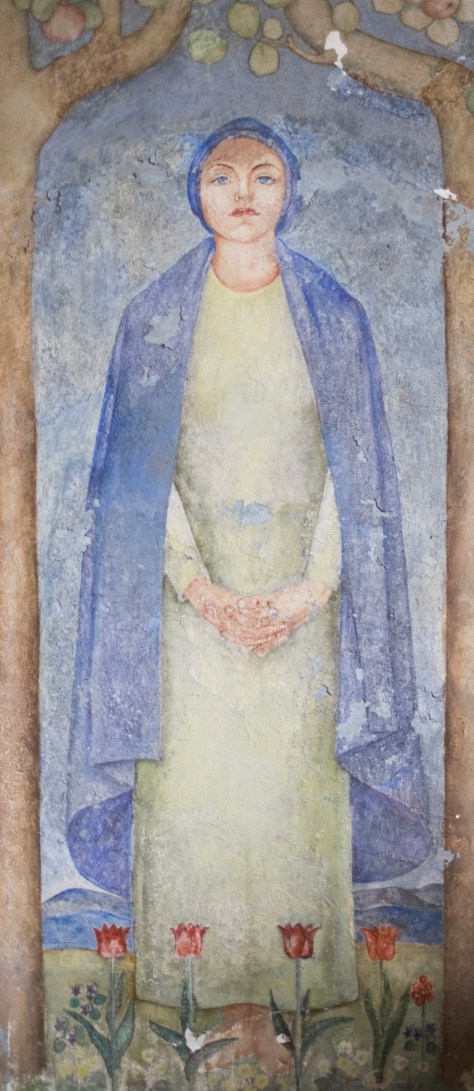
It was a happy, comforting and relaxing evening, an antidote to the February blues that can strike us. It also raised £200 in donations for the Kitty Milroy murals appeal through which we are planning to restore the rare and important murals in the chancel at St Mark’s.

Wendy is holding another musical evening at St Mark’s in May. This one will be a jazz evening in memory of her parents, renowned local journalists and historians Jean and Ted Parratt. It will take place at the church on May 4 from 7.30pm.  A light meal will be included but please bring your own drinks. The evening will also raise money for the Kitty Milroy murals,

Donate a bike, transform a life

If you have a bike you don’t want, or a bike that needs servicing, or you haven’t got a bike and would like one, come along to Bike Start in Browning Barracks, Alisons Road, Aldershot, and in doing so raise money for The Source, a Christian charity which supports young people who are particularly vulnerable or in challenging circumstances.

Bike Start operates on a Monday and Thursday and, as well as servicing bikes either for individuals or to sell them through eBay, Bike Start can teach you how to maintain a bike. It trains groups and individuals in bike maintenance skills and will run charity days and team bonding days for organisations.

The Source works with 11- to 25-year-olds who are isolated, vulnerable, struggling at school, in trouble with the law, have challenging family relationships, are homeless, in care, live on their own or are young parents. It offers counselling, life coaching, mentoring, anger management programmes and support for young parents.

Ellie Jones, director of The Source, said: “We are so very grateful to everyone who supports BikeStart through donating bikes, buying bikes and coming to us for servicing and repairs.  You have made such a difference to the lives of the young people we support and empower.”

To find out more about BikeStart, donate your old bikes or book your bike service visit www.bikestart.co.uk or call 07596 564428.


source bikes


Top picture by Chris Becker, Unsplash.