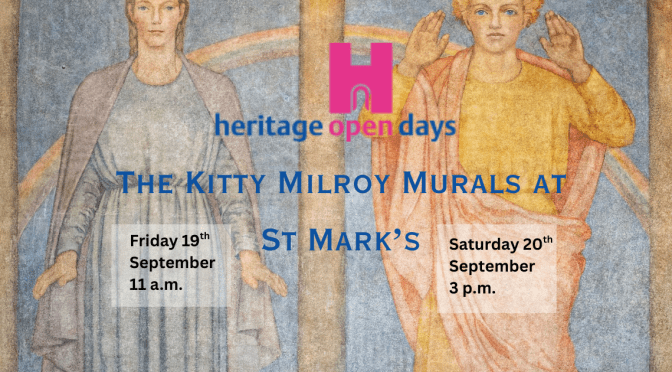
St Mark’s is taking part in the 2025 Heritage Open Days and welcoming people to the church on Friday, September 19th at 11am and Saturday, September 20th at 3pm, to see the Kitty Milroy murals and have all their questions answered by Nick Seversway who is an expert on the subject.
This is an ideal opportunity for anyone who hasn’t yet seen the murals, or would like to find out more, to come along and have a detailed look.
The murals, which are of significant national importance in the development of 20th-century mural painting, were painted between 1911 and 1920 by local woman Eleanor Catherine Wallace Milroy (‘Kitty’) using other local people as models.
The murals are a celebration of faith, seen through the natural world, and include the words ‘O, all ye works of the Lord, bless ye the Lord’ (The Benedicite, a canticle taken from ‘The Song of the Three Holy Children’ from the apocryphal parts of the Book of Daniel) and ‘O give thanks unto the Lord’ (from Psalm 136).
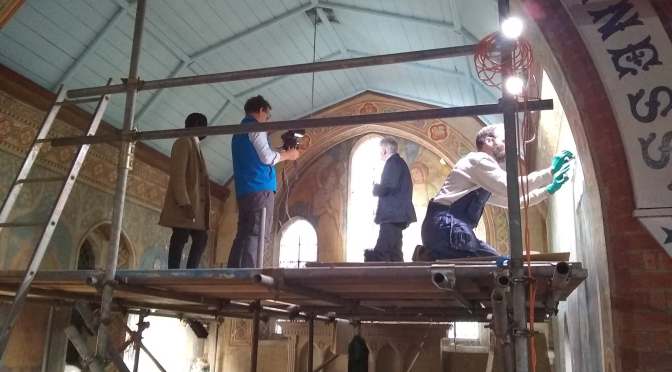
They had deteriorated significantly over the years and in 2021 were restored by internationally renowned mural conservationists Stephen Rickerby and Lisa Shekede.
There is no need to book, so please come along on September 19th or 20th. Refreshments will be served.
Rt Rev’d Dr Christopher Herbert, former Bishop of St Albans, will be giving a talk at St John’s on Friday, January 19th at 7.30pm on ‘The life and times of Bishop Charles Sumner (1790-1874)’ and will be selling his new book there: Building Jerusalem – The Life and Times of Charles Sumner, Bishop of Winchester 1790-1874. Signed copies of the book will be available for £13.00 (cash or cheques only).
Charles Sumner founded both St John’s and St Mark’s and is buried at St John’s. Hale was in the Diocese of Winchester at the time that Charles Sumner was bishop. In fact, the Diocese of Guildford didn’t exist then, but was formed in 1927 from part of the Diocese of Winchester. Bishop Sumner lived in Farnham Castle and founded St John’s in 1844. He then gave land for St Mark’s to be built in 1883 as a daughter church of St John’s, and locals built the church using flints from the nearby common to build the walls.
Charles Sumner also founded Hale School in 1874 as the Bishop Sumner Anglican School.
Bishop Christopher Herbert was Vicar of The Bourne in Farnham between 1981 and 1990, then Archdeacon of Dorking until he was appointed Bishop of St Albans in 1995. He returned to Farnham when he retired in 2009 and he spends much of his time writing and lecturing.
Bishop Christopher has established himself as a respected and sought-after lecturer in the fields of Christian art, spirituality and the ethics of end-of-life care. In each of these areas he lectures across the UK and in Europe. He is a visiting Professor in Christian Ethics at the University of Surrey. The parish is fortunate to have him giving a lecture on Bishop Sumner, so book the date in your diary. To find out more, email news@badshotleaandhale.org or call 07842 761919.
Everywhere we go, the people we live and move among have their own stories. These will be influenced by, and overlap with, the stories of different communities.
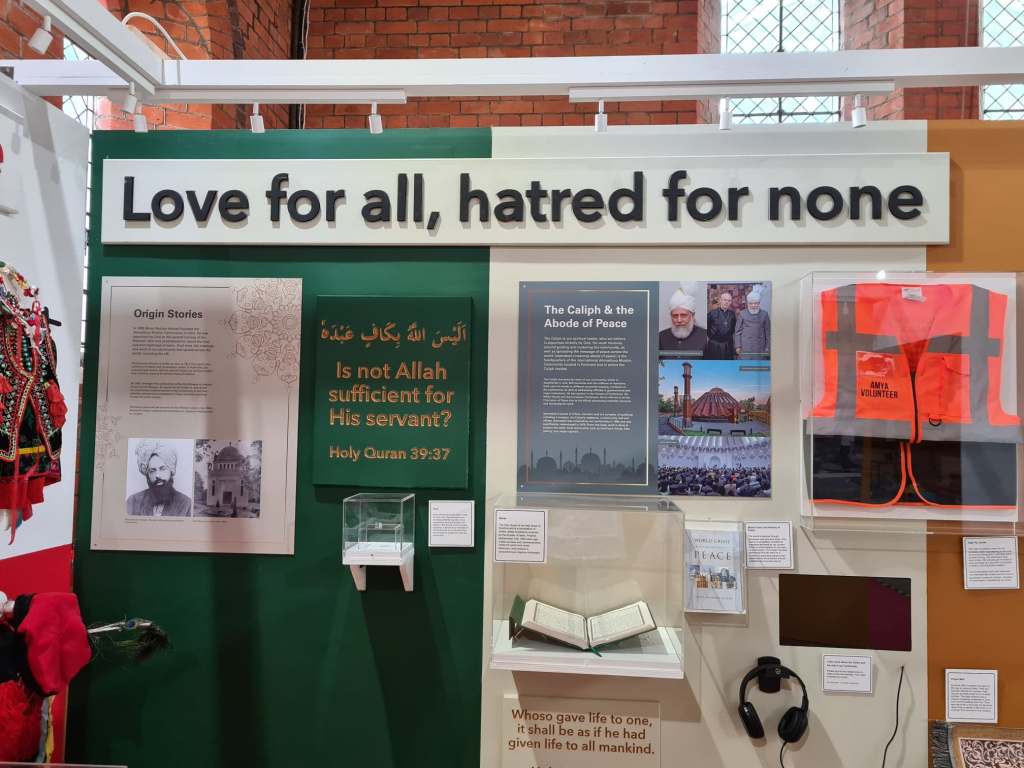
This area is no exception and St Mark’s Church is hosting an exhibition about three communities until July 15. The exhibition will then move to the Museum of Farnham, which has co-curated this, on July 26 where it will remain until December.
Reflecting on 60 years: Our Untold Stories is an interactive exhibition which introduces us to the Ahmadiyya Muslim, the history of Hale and the Polish community in the area. The Ahmadiyya Muslim Youth Organisation, the Hale History Project and the Polish School of Surrey worked with the museum to create a pop-up exhibition about each community’s stories, their origins and specific purposes and provide insight in to the development of local areas.
The exhibition is open at St Mark’s at the following times: Thursday to Sunday, 10am to 1pm, until July 15.
We are now well under way with our work at St John’s. We record everything inside the church, but we also look at changes that have been made to the building to help us with dating items like windows and stonework. Our visits to the archives have revealed some interesting information about the changes made to St John’s since the church was built in 1844.
The first proposed alterations were featured in a previous blog post, and plans from 1844 and 1861 were then recorded in a later post.
However, according to a document at the Surrey History Centre, dated 1st July 1868, other improvements were made including the construction of a porch (whether south or west isn’t clear) which is not shown on the 1861 plan:
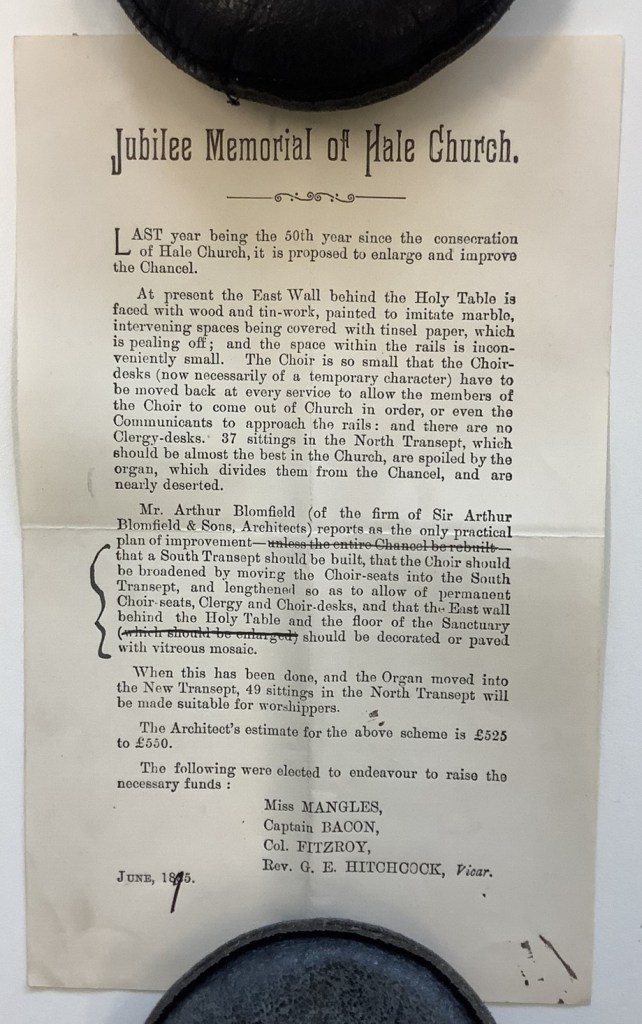
Then in 1895 a ‘Jubilee Memorial’ was proposed, and a draft version of an appeal leaflet found at London Metropolitan Archives during a research visit by one of our team explains why the changes were so badly needed!
The people elected to raise the funds for these improvements include names well known to those who are interested in the story of the church.
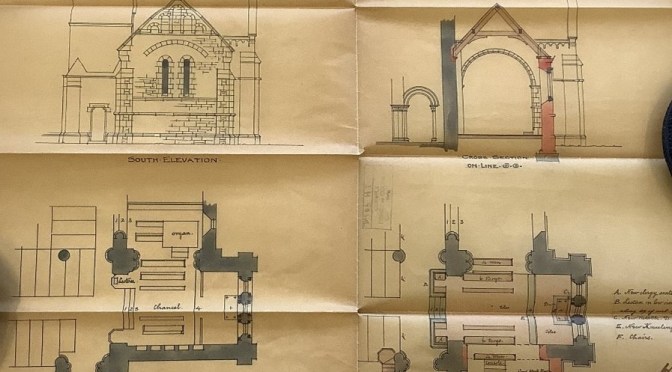
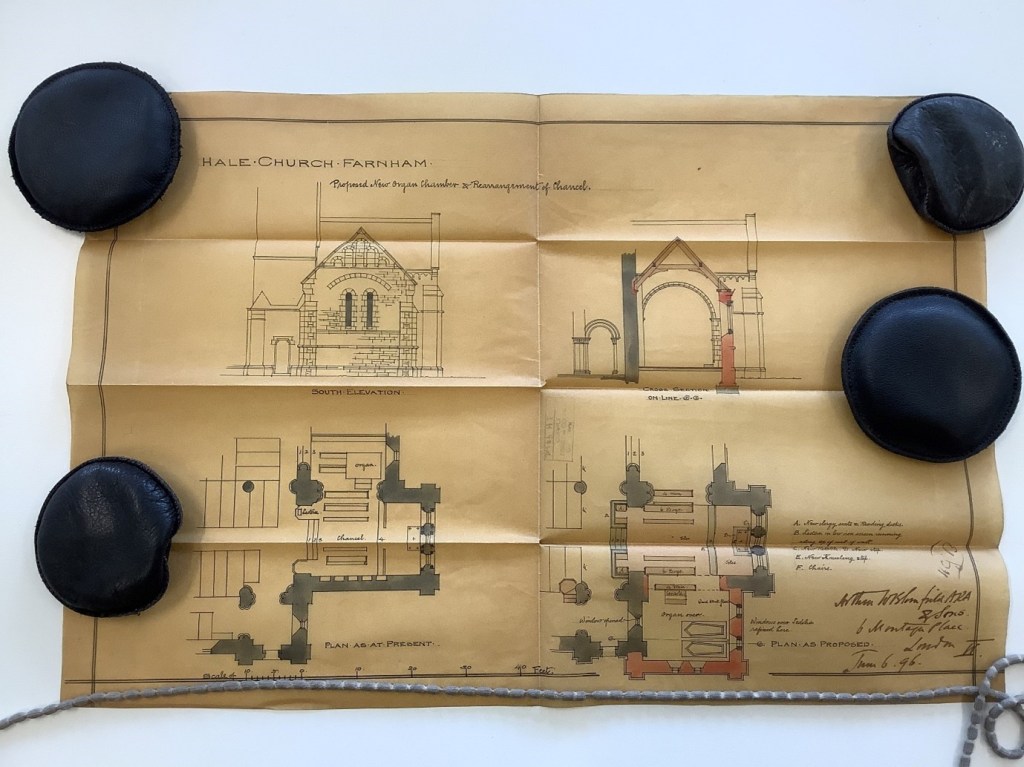
In the same bundle of documents is a plan dated 1896 showing what was eventually built.
It’s well known that Bishop Sumner and his wife Jennie were buried in St John’s churchyard, and we had heard various opinions about the exact position of their graves. The plan shows that they now lie under the vestry. The graves were originally outside the church, and the 1896 extension was built over them. The original gravestones are still in the churchyard but were moved to the east side of the church, and the beautiful memorial plaque to Bishop and Mrs Sumner in the chancel indicates that their graves are nearby. The plaque was designed by the Sumners’ grandson, Heywood Sumner, who was a noted artist in the Arts and Crafts movement.
We’re now looking into the next significant alteration and will reveal our findings in due course…
Farnham Church Recorders are a voluntary group of The Arts Society Farnham. Read about us by clicking here.
The Kitty Milroy Murals at St Mark’s have made the national news, following a visit by Sky News reporter Shingi Mararike.
The murals, which are undergoing restoration at the moment, have been recognised as being of national importance in the development of mural art and the work of a considerable, but so far unacknowledged, talent.
I am sad that this year we won’t be able to enjoy “Pancakes and Temptation” at St Mark’s and a bit nervous that we might just have to make do with the temptation and a lot of wistful thinking. This reminded me that I have never tried the recipes which my great-grandmother Mary Louise had written out into her cookery book.
Mary Louise (pictured above) was the daughter of a vet and she married a man who had inherited a few smallholdings in East Devon. They rented a large house on the banks of the River Exe at Lympstone, which was the childhood home of my Grannie. I am not sure whether Mary Louise would have made these pancakes herself, because according to the 1911 census, they had two general servants living with them.
The cookery book must have been started in the 1890s/1900s with the lavish food available at the time, but towards the end of the book there are recipes suggesting “How to eke out butter” using cornflour and milk. The book ends in 1919. The pancake recipes are from a far more extravagant time. And just in case all the pancakes prove too much, I include Mr Broom’s recipe for Indigestion Powders – but please, please, please don’t try that one at home as I do not want to be held responsible for you trying to obtain the required morphine.
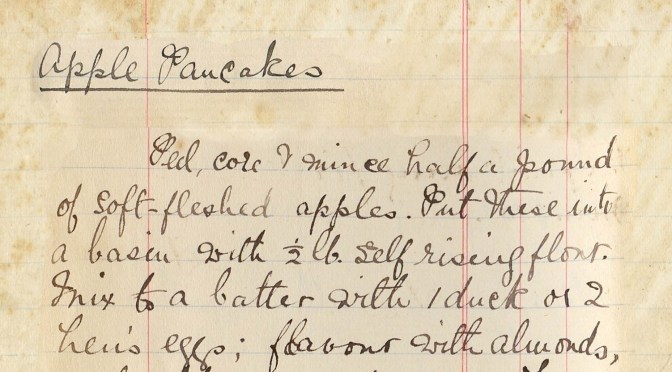
Apple Pancakes
Peel, core and mince half a pound of soft-fleshed apples. Put these into a basin with ½ lb self rising flour. Mix to a batter with 1 duck or 2 hens’ eggs; flavour with almonds, and add one oz of sugar. Fry with lard. Dust sugar over when they are cooked, roll up and serve with quarter lemon.
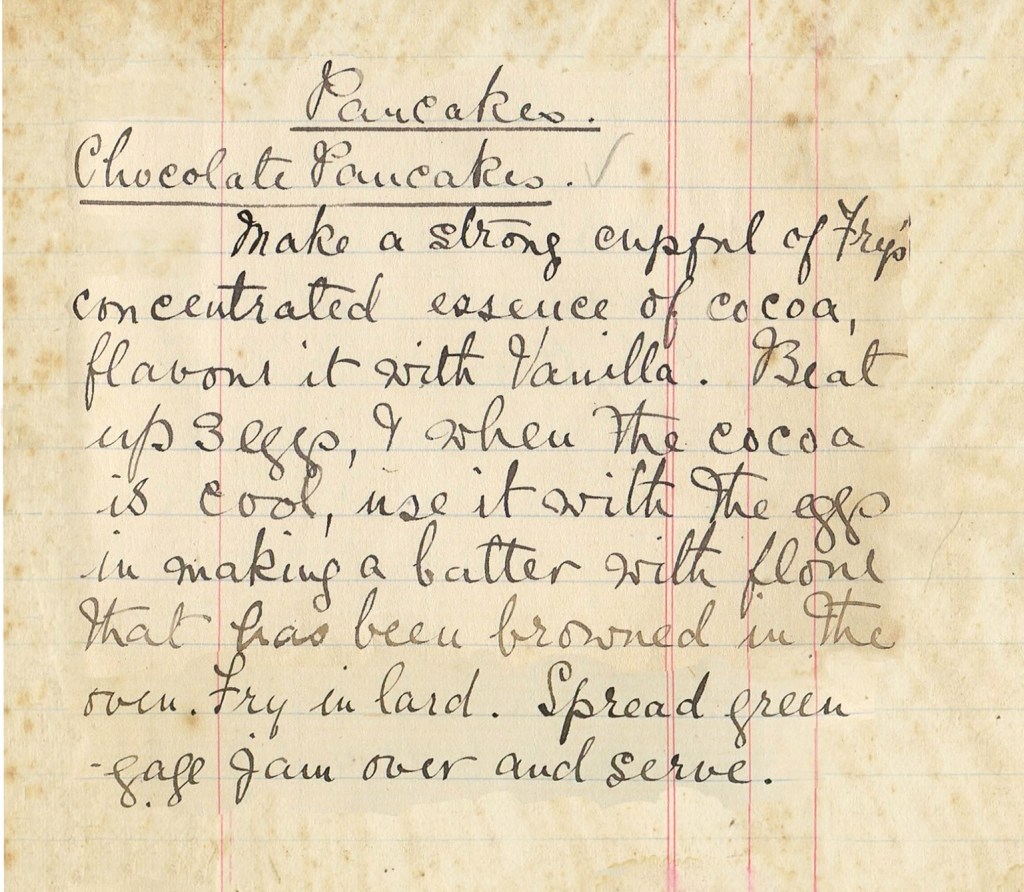
Chocolate Pancakes
Make a strong cupful of Fry’s concentrated essence of cocoa, flavour it with Vanilla. Beat up three eggs, and when the cocoa is cool, use it with the eggs in making a batter with flour that has been browned in the oven. Fry in lard. Spread greengage jam over and serve.
Empress Eugenie Pancakes
They consist entirely of farina, mostly cornflour or potato fecula (a thickening starch). Four tablespoonfuls to two of sugar and 8 eggs quarter of a pint of new milk, a small glass of cognac. Fry in clarified butter, and drop in candied violets and orange-flower (?*) in equal quantities. These delicious bonnes-bouches are crisp and have a peculiarly pleasant taste. They are served on separate plates, and must not be covered down or placed over each other when serving.
* I think this must be orange flower essence, as that is an ingredient used in Napoleonic recipes.
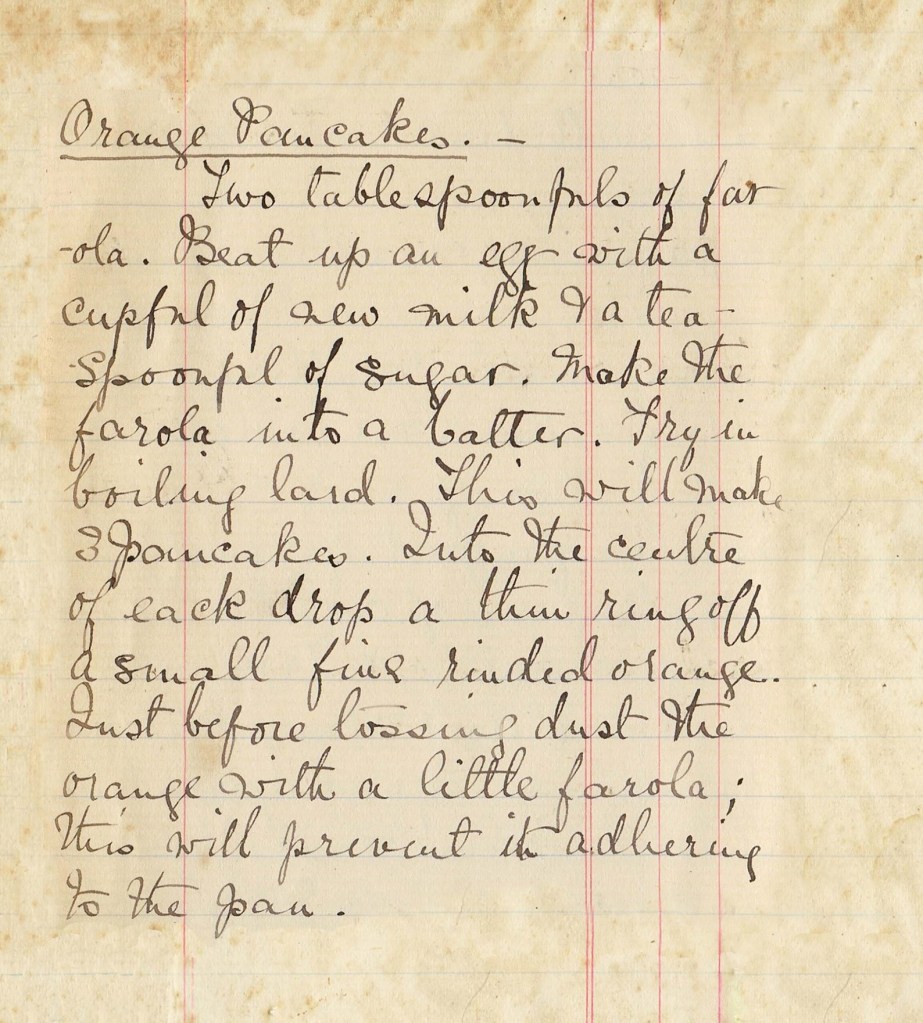
Orange Pancakes
Two tablespoons of farola (A free-flowing cream coloured fine granular powder milled from durum wheat). Beat up an egg with a cupful of new milk and a teaspoonful of sugar. Make the farola into a batter. Fry in boiling lard. This will make 3 pancakes. Into the centre of each drop a thin ring off a small fine rinded orange. Just before tossing dust the orange with a little farola; this will prevent it adhering to the pan.
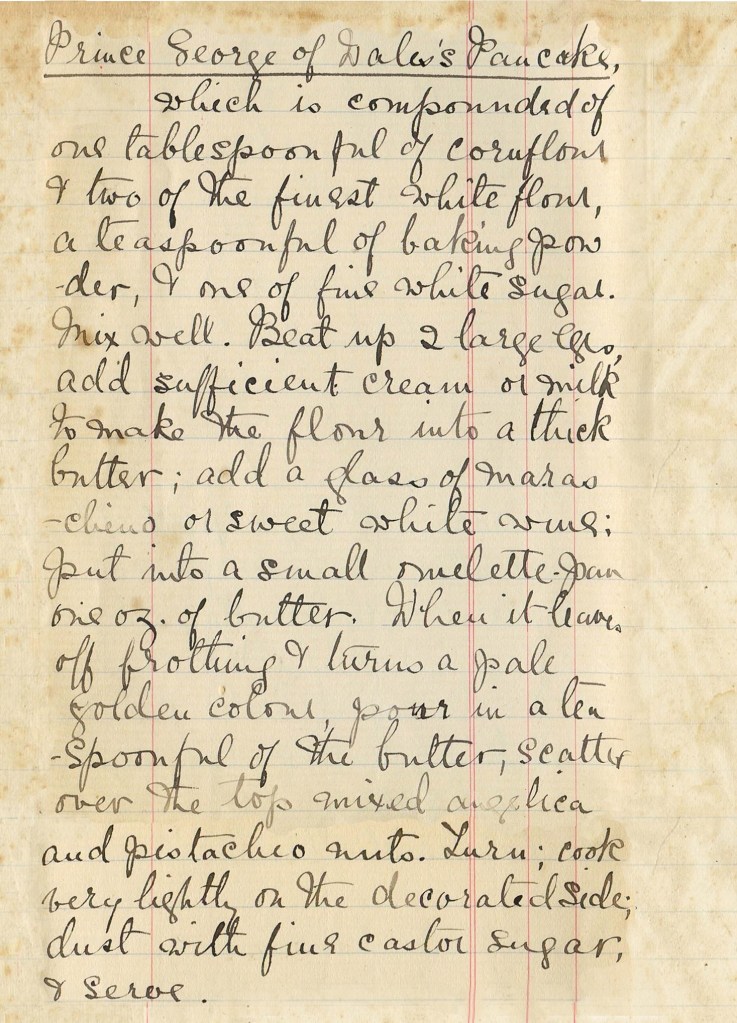
Prince George of Wales’s Pancake
which is compounded of one tablespoonful of cornflour and two of the finest white flour, a teaspoonful of baking powder, and one of fine white sugar. Mix well. Beat up 2 large eggs add sufficient cream or milk to make the flour into a thick butter; add a glass of maraschino or sweet white wine: put into a small omelette-pan one oz of butter. When it leaves off frothing and turns a pale golden colour, pour in a teaspoonful of the batter, scatter over the top mixed angelica and pistachio nuts. Turn; cook very lightly on the decorated side; dust with fine castor sugar, and serve.
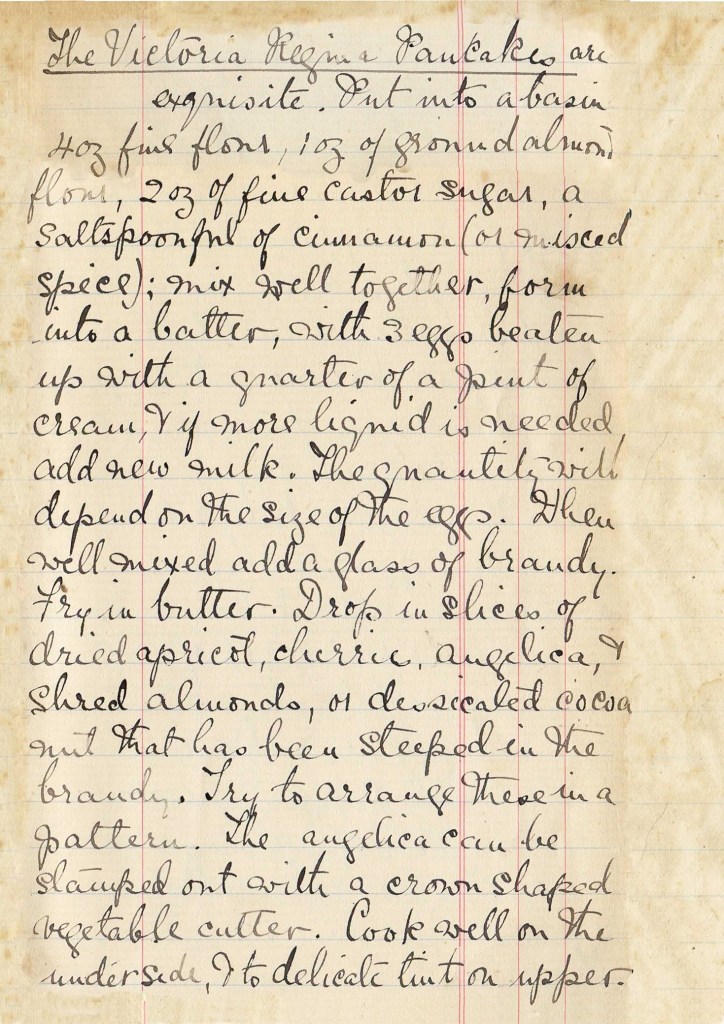
The Victoria Regina Pancakes
are exquisite.
Put into a basin 4 oz fine flour, 1 oz ground almond flour, 2 oz of fine castor sugar, a saltspoonful of cinnamon (or mixed spice); mix well together, form into a batter, with 3 eggs beaten up with a quarter of a pint of cream, and if more liquid is needed add new milk. The quantity will depend on the size of the eggs. When well mixed add a glass of brandy. Fry in butter. Drop in slices of dried apricot, cherries, angelica and shred almonds, or desiccated coconut that has been steeped in the brandy. Try to arrange these in a pattern. The angelica can be stamped with a crown shaped vegetable cutter. Cook well on the underside, and to a delicate tint on the upper.
Mr Broom’s Indigestion powders
Bismuth 100 grs Bicarb Soda 100 grs Ginger 30 grs Morphia 1 gr 10 powders Taken in skim milk immediately before meals.
DO NOT TRY THIS AT HOME! (anyway, it is difficult and illegal to obtain the required morphia)
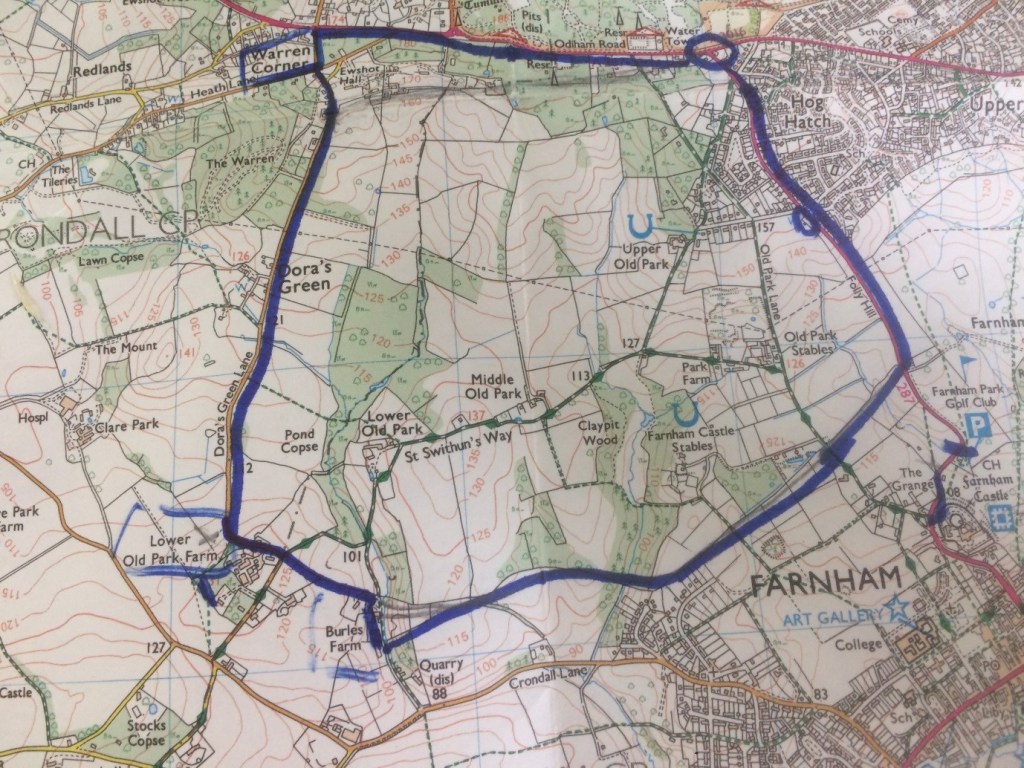
The historic Farnham Old Park was located to the West of Folly Hill and was the original Deer Park for the Castle before the existing (new) Park. The origin of the Old Park is estimated at 1138 when Bishop Henry of Blois built his castle. Deer were hunted in the Old Park by the Bishops and King John from the castle. The Old Park also provided timber, pottery, tiles and osier. The landscape of Old Park is still distinctive and its boundary can still be seen today with ancient species-rich hedgerows running alongside a stream or ditch. The boundary can be traced as to the east by Folly Hill, to the South by a hedge bank running past Burles Farm to Lower Old Park Farm up at Faulkner’s Folly along the West side along Dora’s Green Lane to Warren Corner and Ewshot Hall and then across the Odiham Road to Lawday House Farm.
Bridleways such as Old Park Lane and Middle Old Park follow the course of St Swithun’s Way, a track used for pilgrimages to Winchester. Upper Old Park Lane has the beautiful Cromwell Oak and the Folly from which Folly Hill was named, where the King and his huntsmen hid in wait of deer during the hunt can be seen. The top of the Old Park is Caesar’s Camp (an iron age hillfort and scheduled ancient monument – 1007895), which was included in the Old Park of the Bishop’s of Winchester in the 11th Century. It is a Special Protection Area (SPA) and the Bourley & Long Valley Site of Special Scientific Interest (SSSI) for wildlife namely Nightjar, Woodlark and Dartford Warbler, the three internationally rare bird species. In the time of the Bishop’s it was known as Lawday Heath Common by Lawday House Farm and was where the 100s of Farnham and Crondall met twice a year on “Law Day” for the holding of the Hundred Court. In the mid 1670’s Bishop Morley leased the Old Park to farms to raise money.
The outline of the Great or Old Park – Elfrida Manning 1984
by Jane Watson (shared with permission)
Serving the Villages North of Farnham: Badshot Lea, Hale, Heath End & Weybourne












 The Parish of Badshot Lea and Hale