Category Archives: Environment

St John’s receives Eco Church award

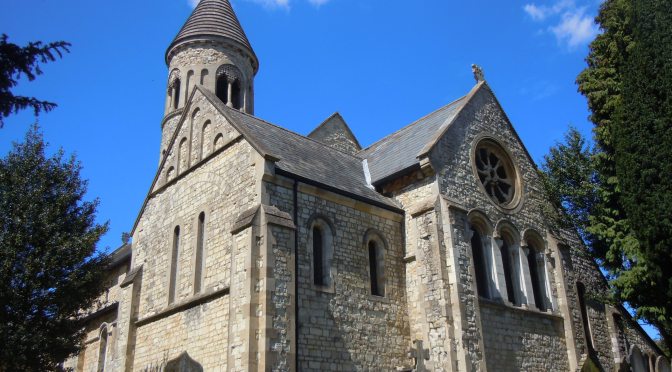
St John’s Church has received a Bronze Eco Church award in recognition of both its commitment to reducing its carbon emissions and of its encouragement of local wildlife.

The church uses renewable gas and electricity and has installed swift boxes on the side of the church to encourage swifts to nest. Swifts have suffered a dramatic decline of 50 per cent in the last 20 years, in large part because of a lack of nesting places, and boxes such as those at St John’s and St George’s in Badshot Lea, are being used to encourage the birds to breed.

Lesley Crawley said: “We are delighted to have received this award for St John’s which means that all three churches in the parish now have the bronze award. The world is in environmental crisis as global temperatures and sea levels continue to rise and species numbers decline. Only this week the Met Office has warned that summers could be five degrees hotter in the UK by 2070, with summer rainfall decreasing and sea levels rising. It is up to all of us to do something if we are to save our planet.”

Eco Church is run by A Rocha UK (ecochurch.arocha.org.uk/), a Christian charity working for the protection and restoration of the natural world. The Eco Church award scheme encourages churches in England and Wales to look at how they express their care for the world in worship and teaching; in looking after buildings and land; in engaging in both the local community and global campaigns, and in the personal lifestyles of the congregation.

There are three levels of award – bronze, silver and gold – and all three churches in the parish are now working towards a silver one.


Celebrate Apple Day!

Everyone is invited to celebrate the fruits of the Hale community orchard on Apple Day, Sunday, October 7, at St Mark’s, at 10am.

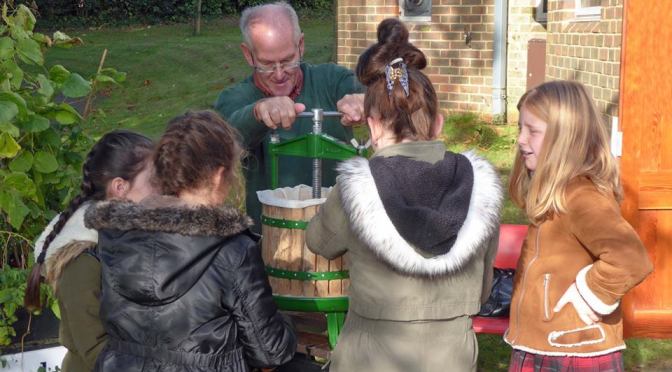
The celebrations will be held in the orchard, which is next to the church, and inside the church hall, and everyone is encouraged to bring their apples and put them in the apple press for freshly pressed apple juice.There will be apple songs, apple pancakes and apples dipped in chocolate, all followed by a celebratory harvest festival service in the church. The Bishop of Dorking, the Right Rev’d Jo Wells, will join in the celebrations and harvest festival.

Rev’d Lesley Crawley explained how the day has come about: “In December 2014 we planted 11 fruit trees to create a community orchard at St Mark’s. Each tree was adopted by a different community group and all except one have thrived since they were planted.

“Our first Apple Day was in 2015 because we were so delighted that our trees were bearing fruit and so we decided to celebrate! Since then we have celebrated every year by having apple pancakes, apple-y music and apple pressing. It is a great atmosphere with children and adults pressing the apples, drinking the juice, eating pancakes, listening to the music and chatting. This year with have the Bishop of Dorking joining us for the celebrations at 10am and staying on for our harvest festival at 11am. Please come and join in the festivities.”

Anyone who wants their apples turned into juice is asked to bring apples that are in good condition, picked from the tree and washed, along with clean two-litre plastic milk cartons, including the lid, to put the juice in.

Come along and celebrate!

Out of the comfort zone and across the Channel

Jonathan Jones is a familiar sight around town – often in green frock coat, wearing a tricorn hat and ringing a bell as befits his position as town crier. From time to time we have seen him dressed in Victorian garb presenting a Dickens and/or Christmas readings evening at St Mark’s Church – he has long been associated with the parish. But just swimming trunks, hat and goggles? This is what he donned in August to take part in a sponsored swim across the English Channel to raise money for Aspire, a charity which supports people with spinal injuries.

The swim was relay-style from Dover to Cap Griz Nez in France, and involved a team of six swimmers, with an observer on board to ensure that everything is done correctly. “Each swimmer takes it in turn to swim for an hour,” said Jonathan. “Once the first rotation is completed, that same order must then be maintained for the rest of the crossing. If, for any reason, a swimmer is not able to take their turn, in the correct order, the team is ‘disqualified’ and the swim abandoned.”

Jonathan was the fifth swimmer. “So just after 8am I got myself ready, which included applying Vaseline to those parts that might chafe owing to the salt water, i.e. under the arms and, for men with beards, around the neck.

“As the swimmer before me, Annie, touched the board, I had to jump over her, into the water behind, before then turning and resuming the swim.

“The sea temperature was just below 18℃ (a public swimming pool is normally 29-31℃) and it was, to say the least, a bit of a shock to the system as I entered. I quickly composed myself, and got into a good rhythm (54 strokes per minute), with the intention of covering at least three kilometres in the next hour.”

As well as a choppy sea, the swimmers had to contend with jelly fish and floating debris, including a lot of plastic which Jonathan was told is increasing each year.

He added “Also, as a consequence of global warming, the sea is now getting a lot warmer, a lot sooner. Our ‘cold water’ qualification, where we have to swim for two hours in Dover Harbour when the sea temperature is 16℃ or less, now has to be done in June, whereas, several years ago, it would be done in July, but by then the sea temperature is too high.”

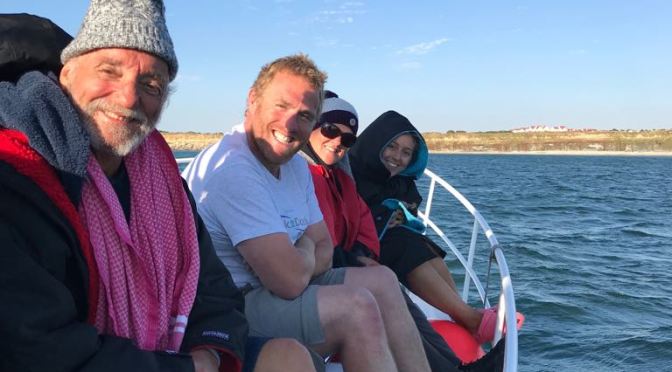
In between Jonathan’s swimming sessions he rested on the boat. “Once out of the water, the important thing is to get some warm clothing on, particularly on the head and feet, and then to get your wet costume off. You have only five minutes to accomplish this. After that, you start to shiver as blood returns to your extremities, and your hands shake so much that you are incapable of doing up zippers or buttons. Hence a ‘buddy’ system, whereby one of the other swimmers is nominated to help you prepare for your swim but, more importantly, assist once out of the water and with getting dressed, before then providing you with a hot drink. All the other swimmers were perfectly alright after a further five to 10 minutes, but it took me about half-an-hour to fully recover.” At 68, Jonathan was one of the older swimmers to take part.

Resting on the boat gave Jonathan a new perspective. “There is a certain beauty to behold out there, in the middle of this vast expanse of water,” she said. “It was a beautiful clear sunny day, and as we watched the sun rise just after 6am, and the gloom lift, the coast of France became clearly visible in the distance, though somewhat still far off. Apart from the steady beat of the boat’s engine, there was a peaceful sense of tranquility in all that vastness, which left an indelible memory that I will forever savour and cherish.”

This slideshow requires JavaScript.

They had to swim with the tides, which did not all turn as expected, and the final swimmer landed at Wimereux, 14 kilometres south of where the team was heading. However, they reached the other side in the correct order in 14 hours and 29 minutes. The return took two-and-a-half hours.

Jonathan said he decided to take part in the swim “primarily because of the challenge it posed, and the opportunity of taking ourselves out of our comfort zones. But secondly, to raise monies for the Aspire charity, which provides much-needed support to people with spinal injuries, and which, since 2009, has been organising these Channel relays. Between the six of us, we will have raised over £20,000 for Aspire.”

He has further watery ambitions: “My personal goal is now to complete the six-hour qualifying swim in Dover Harbour sometime next summer. After that? Well, the oldest person to successfully complete the crossing was a 73-year-old South African heart surgeon. So, in 2023/24, God willing, I may attempt to enter the record books. Watch this space!”

To donate, visit www.justgiving.com/fundraising/jonathanfjones

Swift boxes at St George’s

Yesterday nine new swift homes were added at St George’s Church, Badshot Lea. This was organised by Colin Wilson of the Blackwater Valley Countryside Trust. The boxes were built and installed by Paul Mascall and Peter Robertson, local carpenters who gave up their working time to help us.

Soon they hope to install a sound system to attract the swifts that were flying over their heads as the boxes were being installed. Colin says that “In the small churchyard there are many sparrows so there may be a battle next year for the spaces!”

We are incredibly grateful for those who gave their time to help install these boxes. Swifts need our help in finding nesting sites and hopefully nine families of swifts will soon be making use of their new homes. Thanks to to Bill Thomas, our churchwarden, who organised it all.

St George’s is an Eco-church and we want to do all we can to care for God’s creation.

Lesley Crawley


This slideshow requires JavaScript.

Swifts at St George’s?

The Garden is very soggy at time of writing and little work has been done but moving Swiftly on….

At the last group meeting it was suggested that we explore the possibility of having Swift boxes put up on the church. The organisations to speak to were found to be The Blackwater Valley Countryside Trust and Tices Meadow Nature Reserve.

I met their representatives at the church for a site meeting. Firstly they gave me the background as to why Swifts need our help.

Swifts are in trouble. Their numbers are declining and have more than halved nationally since 1995. They nest in eaves and because old buildings are being demolished and the methods of new building their nesting sites are disappearing.  We are fortunate in our area as there is a fairly healthy population but they could still do with our help.

The eaves of St. Georges Church are ideal for creating a nesting site and because of the way they “stick out” from the wall we are able to provide an hotel rather than individual boxes which means more room for more lodgers!

The “hotel” will be fitted to the eaves of the west wall, from the southeast corner to the first buttress. It will be constructed with wood and screwed to the eaves with no drilling into the church wall. It will be virtually invisible to the casual observer. There is no cost to us as the people who make and install them are specialist volunteers who provide their expertise and materials.

Now, I expect that some of you might be thinking, “what about the mess?”. I am assured that Swifts do not deposit their guano down the walls of their nest sites but jettison it whilst in flight. Sou`westers anyone!!

The “hotel” will be installed by May this year before the Swifts return from migration. The conservationists will install, temporarily, some sound equipment which will broadcast recordings of the screeching call of Swifts. Hopefully this will encourage them to explore the site and take up residence.

We will be joining The Kilns in Badshot Lea and The Roman Catholic Cathedral in Aldershot who have also agreed to boxes or hotels on their buildings.

I hope they like us!

Bill Thomas


Prudence the Piggy went to HSBC

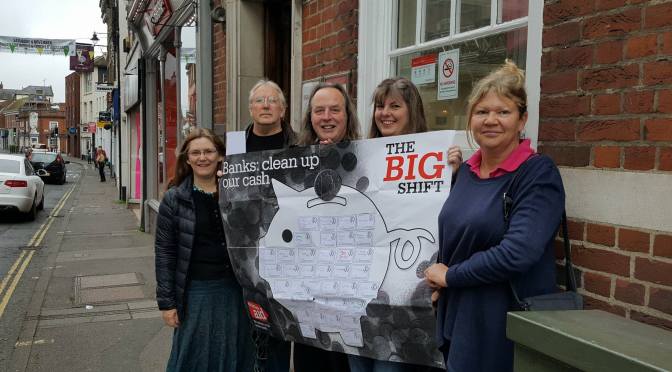
rudence the pig visited HSBC Bank in Farnham last Thursday to ask the bank to stop investing in fossil fuels and instead put its money into renewable energy.

Prudence bore the signatures of members of the churches of St George’s, St John’s and St Mark’s in the parish of Badshot Lea and Hale, and was presented to the bank by the Reverends Lesley and Alan Crawley, joint rectors in the parish, along with parishioners Helena and David Walker and Sorrell Price.

Lesley Crawley explained that the pig was a petition and was part of the Big Shift campaign by the charity Christian Aid to ask the banks to change where they invested their customers’ money and to put this money into renewable energy for the sake of the planet.

She told a representative of HSBC: “We want the bank to divest from fossil fuels and invest in something either neutral or good to help counter climate change.”

HSBC agreed to accept the petition and to send it to head office, where it will join others from around the UK.

Rev’d Crawley added: “Laura Mead, the regional co-ordinator at Christian Aid, contacted all the banks in Farnham to ask them to accept the Big Shift petition, but HSBC was the only one who would receive us.”

For more information on Christian Aid’s Big Shift campaign, visit www.christianaid.org.uk/campaigns

Stella Wiseman