Category Archives: St John’s Church

Car inventor’s grave restored at St John’s

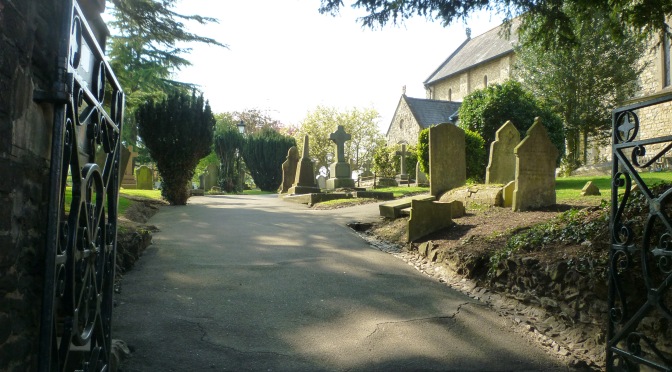
One of the most famous graves in the churchyard at St John’s – that belonging to the motor vehicle inventor John Henry Knight – has been restored.

The grave dates from 1917 and had fallen into disrepair so we sought and received the go-ahead from John Knight’s descendants to repair the monument.

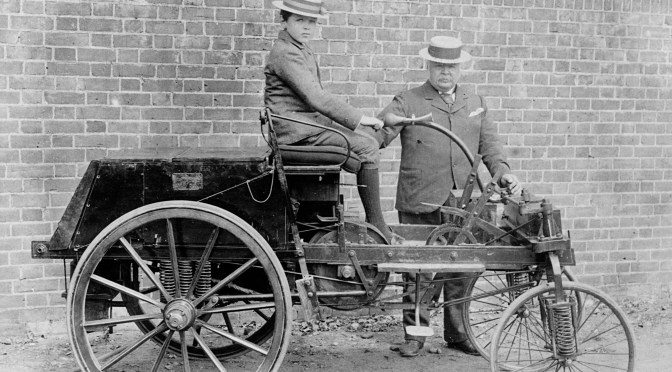
John Henry Knight, who was born in 1847 and lived in Weybourne House, Weybourne Road, invented one of Britain’s earliest petrol-powered motor vehicles. In October 1895 he also went down in history as one of the first recipients of a motoring fine when he and his assistant James Pullinger were found guilty at ‘Farnham Petty Sessions’ in Farnham Town Hall of using a locomotive without a licence and of not having a red flag carried in front. James Pullinger had been stopped while driving the vehicle in Castle Street, Farnham, earlier in the month. The car can now be seen in the National Motor Museum, Beaulieu.

John Knight pleaded not guilty on the grounds that the vehicle was too light to come under the Traction Act, but he and Pullinger were both found guilty and received a fine and costs. After that, he ran the vehicle on a private road but even then was nearly caught by a policeman hiding in a hedge. John Knight stated afterwards in his Recollections that this was “probably the first police trap on record”.

John Knight was responsible for several other inventions, including a steam-powered hop-digger, a brick-laying machine, a grenade-thrower, a radiator and a ‘dish lever’ for tilting plates when carving meat. Appropriately, given his motoring brush with the law, he also invented wooden vehicle tyres and a speedometer.

John Knight had also built a steam carriage as far back as 1868 and drove it on the roads around Farnham. According to contemporary writer William Fletcher this could carry three people at up to eight miles an hour and “easily mounted the hills in the neighbourhood of Farnham”, though John Knight himself admitted that “breakdowns were frequent”.

Lesley Crawley commented: “John Henry Knight seems to have been a colourful and clever man who was always using his ingenuity to create something new and solve problems of the day. Everyone in the parish has the right to be buried in our churchyard and everyone is equally special and equally loved by God. I find it humbling to think of all the people who have been associated with the church over the past 175 years and who will be in the future. The church is for everyone from the most eccentric inventors to the quietest passers-by.”

The grave.

Weybourne House 1Weybourne House where John Henry Knight lived as a child.

Pictured top: John Henry Knight (standing) with his vehicle in 1895. Picture courtesy of the National Motor Museum, Beaulieu.
Inspiring vision and pathways to prayer

Lent is as much a time for taking up new habits as it is for giving up old ones, and one of the habits we are encouraged to develop is that of prayer.

Sometimes we need new ways into prayer and one such is being offered this Lent at St John’s on a Wednesday evening from 7.30pm – using the visual arts to provide inspiration and pathways to prayer.

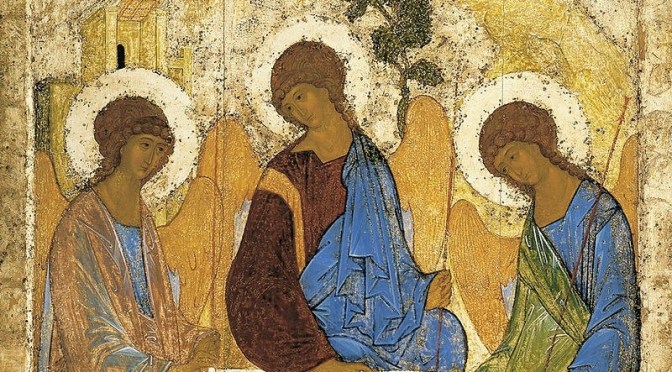
The first was Wednesday this week, when a small group considered ‘Prayer and the Trinity’, meditating on the painting Holy Trinity by Rublev, reading a passage from Paul’s letter to the Colossians (chapter 1, vs 3-14) and considering the creator, saviour and inspirer – Father, Son and Holy Spirit.

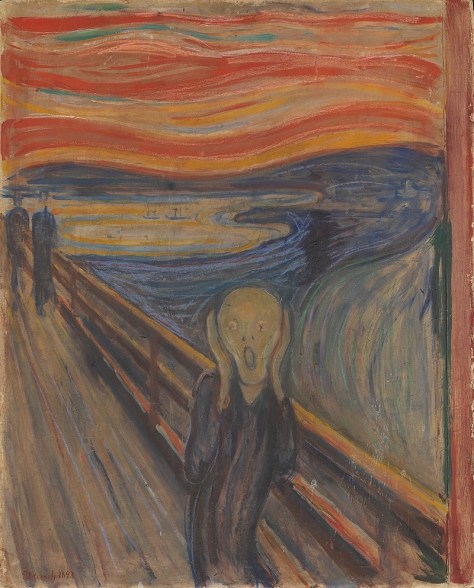
Next Wednesday, we will look at Prayer in Challenging Times and the painting The Scream by Edvard Munch, and in subsequent weeks Prayer and Discipleship, and Caravaggio’s The Call of Levi; The Joy and Excitement of Prayer with The Visitation (Mary and Elizabeth) from the Church of the Sitio, Suchitoto, El Salvador; and finally Repentance and Forgiveness with Rembrandt’s The Prodigal Son.

Come and join us and find new ways in to prayer through art.

the scream

Pictured above: The Scream by Munch

Pictured top: Holy Trinity by Rublev

Concert for Christian Aid and churches

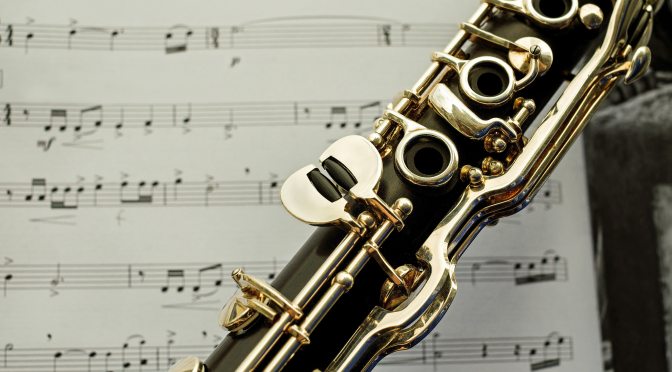
The Blackwater Valley Wind Quintet are staging a concert of classical music in aid of Christian Aid and the Parish of Badshot Lea and Hale at St John’s Church, Hale, on Saturday, February 16, at 7.30pm.

There will be a varied programme which will include pieces by Mozart, Vaughan Williams, Schumann and Gordon Jacob, and alongside the Blackwater Valley Wind Quintet will be other local performers.

Tickets (£10, £8 concessions, to include refreshments) are available from 07730009317 or 07519740607 or by emailing g.weston321@btinternet.com. Tickets may be available at the door.

Please help us find the relatives of these people buried at St John’s, Hale

Some of the gravestones in St John’s churchyard have become very unsafe and we are worried that someone might be hurt as a result. The maintenance of gravestones is the responsibility of the families of the loved ones, however, if we are worried about them from a safety point of view we have the right to lay the stones flat. We don’t really want to do this and so we urgently would like to contact the relatives of the following people as we believe that their gravestones fall into this category.  If it is you, or you know who they might be please would you let me know?

Ethel Matthews
Fredrick Lipscomb
Henry Tompkins
Harry Beaumont
George Cantwell
Wilfred Park
Eaustania Fagan
Jill Stares
Lotti Raynsford
Ivy Biddle
Charles Stent
Albert Woodhams
Frances Wilkinson
Samuel Bide

Thank-you so much

Lesley Crawley

Hear God in the stillness

There are two new services being introduced into the parish in the next few weeks, both of them opportunities to have some stillness and pray.

The first is Said Evensong from the Book of Common Prayer (BCP), a service beloved by many but which has declined in popularity in the last few decades. The second is a Taizé service, a simple service based on chants and silence.  They will take place monthly for  a trial period of six months, starting with Evensong on the final Sunday of the month at 5pm at St George’s, Badshot Lea – January 27 is the first one – and Taizé on the first Sunday of the month at 6pm at St John’s, Hale, with the first one on February 3.

The idea is to give us a chance to find some stillness so that we may hear God speak. Lesley Crawley says: “It feels so amazing, miraculous even, that God speaks to us ordinary folks and our lives are transformed forever.

“I believe that to experience such things we have to deliberately put ourselves in the way of God. We won’t hear God speaking unless we make time and space to do so. In our parish there is so much going on that sometimes I wonder whether God can accidentally get sidelined; and so we are offering two opportunities each month to have some additional stillness and prayerfulness. These will be located in particular buildings but are for everyone, irrespective of whether you go to a different church, or no church.”

BCP Said Evensong has been chosen by Lesley because it is a service she has loved since she discovered it during her curacy. She says of this discovery: “I loved the BCP, I loved the poetry of the language, I was charmed by the way that words have changed their meaning, and I enjoyed using those words with their old meaning. I found particular words and phrases incredibly challenging or comforting or meaningful – they pulled me into the presence of God. I loved the way that words were paired together like peace and concord, celebrating the depth and range of our language and behind that the diversity of all the peoples with their languages over many centuries who have come together to make our complex and many-faceted nation. The repetition was also helpful – saying almost exactly the same thing each week meant that I could experience the same words that had so blessed me the previous week and I found that those words continued to bless me from then on, week in and week out.”

Taizé has been chosen as a ‘doorway’ through to a closer experience of God. Lesley says: “I find that the experience of chanting enables me to step through the chants into the presence of God. Perhaps it is because I’ve always found it easier to learn things that are sung rather than said. For instance, at school I was rubbish at learning poems but I knew lots of pop songs off by heart! The chants are in various languages (although I tend to stick to the English and Latin chants) but actually language is irrelevant, it is just a tool to step into that place of intimacy with God.”

Craig Nobbs will be leading Said Evensong at 5pm St George’s on Sunday, January 27, and thereafter on the last Sunday of the month. Come along if you love BCP or have never experienced it and be swept along with its beauty.

Lesley will be leading the Taizé service at 6pm at St John’s on Sunday, February 3, and thereafter on the first Sunday of the month.

Lesley adds: “If neither of these services speak to you but something else will help you draw closer to God then please do that, and if you want some help setting something up then please contact me”.


Emily and the Generations on the radio

Emily and the Generations may sound a little like a pop group, but today’s blog post title actually refers to an interview with Lesley Crawley on BBC Radio Surrey this morning (Sunday, Jan 13).

She was interviewed on the Sunday Breakfast show about our final push to raise money for Emily the organ – just £559 to go folks, come on, we can do it – but the interview spanned far more than just Emily, important and beloved as she is.

Interviewer Emily Jeffery talked to Lesley about how Emily the organ is a beloved part of the community and how her overhaul will allow us to use her again in worship, concerts and for children to learn on.

Then the interview broadened out to something that is also dear to our parish – the way we try to bring old and young and in between together.

Lesley spoke about the fact that local school children will be welcomed in to see the organ when it is being restored, how the table tennis club we run has become a ‘youth group for all ages’, the fact that we don’t send the children out of church for a separate Sunday school (“we are an inclusive church … and it seems wrong to send out part of our congregation”), the plans for opening St John’s up more to the community and bringing people together with a café, and other resources, perhaps even a nursery which could link in with a local care home.

To hear the interview click here and go to 2:38:52.


Picture by Will Francis. Unsplash.


Have your say on the future of St John’s

As St John’s Church turns 175 this year, we are launching a major improvement and fundraising project and want to know what facilities you would like the church to offer.

Residents and local organisations are invited to complete a short survey to help us learn more about what our community needs and how the church can better provide this.  It can be found by clicking here.


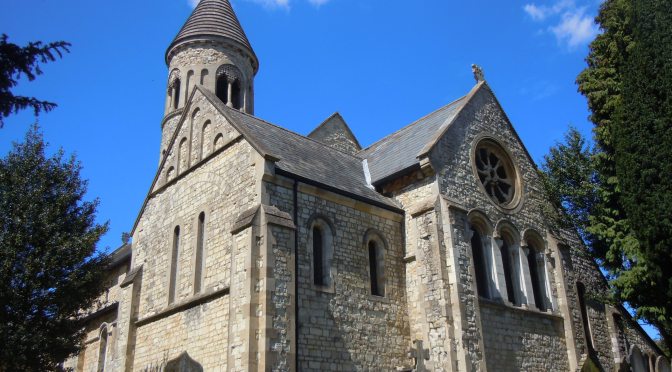
St John’s Church is 175

Come to the 175th events:

Flower Festival
May 18th 10-4pm and May 19th 12-4pm. Entry £1, refreshments available.

Talk on Modern Slavery and Human Trafficking
May 22nd 7pm
Bishop Charles Sumner, who founded our church was a relative of William Wilberforce and so I seems appropriate as part of the 175th anniversary celebrations that we look again at slavery. Modern day slavery and human trafficking is going on around us now and we need to have our eyes open to it and learn what we can do to combat it. Suzette Jones, the Diocesan Health & Wellbeing Adviser, will give a talk at St John’s to help us all understand what we can do.

Talk from Christopher Herbert on ‘Art, Architecture and Christianity in Victorian England’
June 5th at 7:30pm. Donations welcome, refreshments available.

Art and Craft Exhibition
June 22nd 10-4pm and June 23rd 12-4pm. Entry £1, refreshments available.

BIG Party entitled ‘Music in the Churchyard’     
July 20th 12-2pm. Free of charge for the whole community. There will be music, food and lots of cake. All are invited, please let us let us know that you are coming so we can get the catering right. Email pamelaanne.m@btinternet.com

Afternoon Tea Singing and Reminiscing

Aug 3rd 3-5pm. Free of charge and open to all. There will be a cream tea and lots of opportunity to join in the singing.

Celebration service with Bishop Andrew presiding

Nov 24th  at 9:30. Please come and join the service, followed by our 175th birthday cake!

Please also write about what St John’s Church means to you in 175 words and email it to news@badshotleaandhale.org. The writings will be published here so let us know whether you want it to remain anonymous.

Also – please complete our community survey by clicking here

Mary, faith and holding on

When I was nine years old, I remember having a discussion with my friend, Cherry, at school about how babies were made. She thought boys had something to do with it. I asked my mum and dad about it after school that day and they sat me down in our dining room and told me the biological facts of human reproduction. I burst into tears. It was all a bit too much for me that day, even though, to this day, I remain grateful to my late parents for their courage, honesty and clarity in telling me the Facts of Life.

My mum, Jean, was told nothing at all on this subject by her parents. When she was nine years old and her younger sister, Margaret, was born, my mum looked in the dustbin for the eggshells from the eggs which she thought her mum must have laid when the baby was born!

After my parents’ honest chat with me, they gave me a Ladybird Book called The Human Body which contained the details they had explained to me (plus colour drawings!) and which also explained digestion, respiration etc. That book gave me a lifelong interest in how the human body works in sickness and in health.

Mary, the Blessed Virgin Mary, the mother of Our Lord Jesus Christ, was probably only 14 or 15 years old when Jesus was conceived within her by divine, not human, means. Initially fearful and confused as to how this promised baby could possibly be created without the help of a man, Mary then demonstrates an impressively open-minded, trusting and humble faith in the fulfilment of God’s promises to send a Saviour, Jesus Christ, whose kingdom will have no end.

So, what does such a young girl as Mary do in this highly irregular, not to say potentially shameful situation, of being pregnant but not being married? Remember also that a standard human baby would have been enough of a worry, but her baby was nothing less than the Son of God.  A pretty tall order for one so young.

As many women have done before and since, Mary seeks female support and travels from the one-camel town which is Nazareth – it possibly only had around 150 inhabitants – for four days into the hill country of Judea to her much older relative (probably her cousin) Elizabeth who is six months pregnant with John the Baptist. Some scholars believe that Joseph may have accompanied Mary on this potentially dangerous and arduous trip at the start of a pregnancy which will also end with an arduous trip but that time to Bethlehem. We can only imagine the conversations between Zechariah, Elizabeth’s elderly husband and Joseph, if Joseph did go along to Elizabeth and Zechariah’s home with Mary.

I wonder whether Mary was sure of the welcome she would receive from Elizabeth? Might Mary have feared criticism or rejection by Elizabeth? Perhaps, just perhaps, Mary was nervous about their meeting. I have no doubt that on her long journey, Mary would have prayed for a happy meeting. Her prayers are answered, if so, in spades.

As Luke describes it, what happens when Mary does eventually arrive at Elizabeth’s home is a wonderful scene, quite rare in the Bible, of a very pure, intimate, domestic demonstration of female bonding, unshakeable faith and mutual empowerment.  Though Mary’s pregnancy probably does not yet show physically, Elizabeth, wife of the Jewish priest, Zechariah, knows with eyes of faith that the child Mary carries within her is indeed Our Lord Jesus Christ.  John the Baptist, as an unborn baby, moves within Elizabeth’s womb when Mary greets Elizabeth. The Bible states that the unborn John ‘leapt for joy’, possibly a little bit of literary exaggeration but entirely appropriate for such a significant encounter with the divine Son of God.

Elizabeth calls Mary blessed because, she says, the fruit of Mary’s womb is ‘my Lord’ and because Mary believed that she would conceive and bear a Son even though Mary had absolutely no idea how it would happen.

No idea how it would happen……. Do you currently have no idea how you are going to get through a particularly testing time in your life?   Do you have no idea where money is going to come from? Do you have no idea how a personal disagreement or problem is going to be solved?  Do you feel up against it, muddled, confused, with no idea about something you simply do not understand?

Try singing your prayers, as Mary did in her beautiful, praiseful, worshipful, well-known song called The Magnificat.  Singing may relax you enough so that you can start to see God opening a door you did not see before. Keep an open mind and stay humble, believing, as Mary did, that nothing is impossible with God but do also, as she did, seek support and advice from other trustworthy sources. Dig deep within yourself to find the child-like faith Mary had in God who puts to flight proud hearts and stubborn wills, who feeds the hungry with good things and lifts up the lowly. Believe with all your heart, that, as we sing in the hymn Tell Out My Soul, God’s promise to each and every one of us, is firm and his mercy from age to age is sure and unchanging. He will bring us through every time of testing. Tears will last for a night, but joy will come in the morning.

From a sermon by Wendy Edwards, preached at St John’s on Sunday, December 22.


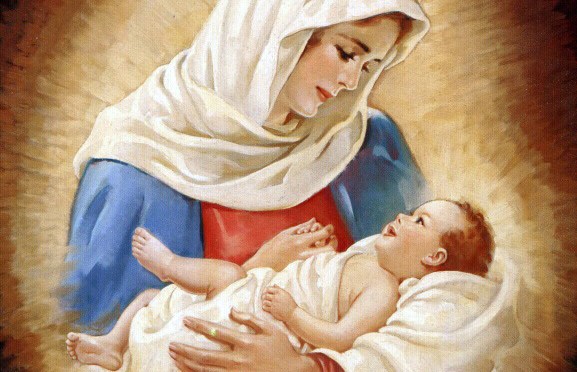
Picture: Waiting For The Word, Madonna – Mary & Jesus – artist Warner Sallman. Creative Commons.

Christmas – a story of hope and unity

This Christmas, come and join us at services at any of the three churches – St George’s in Badshot Lea, St John’s in Hale, St Mark’s in Upper Hale. For details of services, see here. For details of why you may want to, read on.

Human beings are natural storytellers.  It is something that defines us. We love stories, we define ourselves by our stories, in them we find identity. We even turn things that aren’t really stories into stories because everything needs a story for us to find it plausible; if there is no story then we don’t really register what we are hearing; lists of names or facts or equations generally bore us.

More than anything we need stories of hope and stories to unite us. These are the best stories and they are even better if we tell them from one generation to the next, including the children in the telling. I love the Jewish tradition of Passover, with the unleavened bread, the bitter herbs and the four glasses of wine representing hope, and the youngest child asks the question four times in different ways “Why is this night, of all nights, different?”

The story of Christmas is part of the greatest story ever told, and for me it is the most shocking part, that 2000 years ago a baby was born who united heaven and earth, united God and humankind, and this baby was born in humble circumstances. This baby was worshipped by angels in heaven, poor shepherds who lived locally, and rich magi who had travelled from afar. The baby gets a name “Emmanuel” which means “God with us”, and in that name is our hope and our unity, God is with us… Wow…

We remember this each year, we act it out at our crib services, we involve our children, so that we all know the story. We know that Herod was horrible, we know that there was no room at the inn, we know that Mary was a virgin (even if some of us don’t yet know that word means!) and that she travelled a long way on a donkey whilst heavily pregnant. During the rendition of this story some of the women who have given birth smile at the depictions of Mary’s labour, there are usually a few costume malfunctions, sometimes we struggle to find a Joseph (understandable really), and we all sing carols. The story doesn’t get old or tired.

We also remember this story each year at the “First mass of Christmas” – Midnight Mass – when the church is lit with candles and the organ plays the carols we know so well. Everything is more magical at night time, we wait up past our bedtimes with expectation and with joy, joining together as a rather disparate community, all with one intention, to see in this special day where we celebrate the birth of our Saviour. There are some who come to church only once a year to this service, there are some who have come from afar who are staying with friends or relatives, there are some who have just come from the pub; last year we had some who were Muslims and who had never been to a service in their lives before, and there are some who are regulars at that church. This is the magic of Christmas – the ability for this story to bring us all together in hope.

I love the poem “Christmas” by John Betjeman that we hear each year at the carol service at St John’s. It ends with a question:

And is it true,

This most tremendous tale of all,

Seen in a stained-glass window’s hue,

A Baby in an ox’s stall?

The Maker of the stars and sea

Become a Child on earth for me?


And is it true? For if it is,

No loving fingers tying strings

Around those tissued fripperies,

The sweet and silly Christmas things,

Bath salts and inexpensive scent

And hideous tie so kindly meant,


No love that in a family dwells,

No carolling in frosty air,

Nor all the steeple-shaking bells

Can with this single Truth compare –

That God was man in Palestine

And lives today in Bread and Wine.


And is it true? Why is this night of all nights different?

I pray that your Christmas will be joyful and give you hope, I pray that you will find unity and community in your travels this Christmastide and I pray that this will bless you throughout 2019.

Lesley Crawley