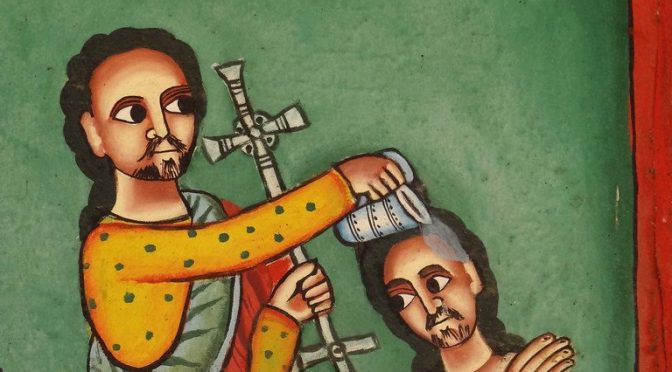
What is the source of John’s question?
- Was it asked on his own behalf, or on behalf of others?
- Was it a question of impatience – when was Jesus going to start judging, or was it one of misunderstanding the role of Messiah.
- Did John know Jesus was the Messiah before he was imprisoned? Or is it dawning on him? This requires that we assume that the author of this pericope did not know Matthew 3:14ff.
The answers Jesus give are oblique. One approach is to look at the political situation – If Jesus had said “yes” then Herod would have heard this on the rumour mill, and it would have been a direct challenge. By quoting scripture Jesus can claim Messiahship without upsetting Herod.
However, in the answers all the evidence of what Jesus is doing involves compassion and healing rather than judgement and condemnation. John preached divine holiness with divine judgement and destruction – see last weeks winnowing fork and axe – Jesus preaches divine holiness and love. Perhaps this is why John is asking – Jesus doesn’t match with his expectation.
Jesus questions about John are in fact a questioning of Herod – again however, without providing Herod with enough evidence to hang him.
a reed shaken by the wind can mean two things
- a proverb for the commonest sights
- a weak waverer
Herod’s coins had a symbol of a reed on them, and Herod himself was seen as a waverer. John was neither of these. People do not go out into the desert to see either.
soft/luxurious robes were the sign of a courtier – a flatterer of Kings – which was far from John.
Prophets have a message from God and the courage to deliver it. John was certainly this.
Elijah was expected to return before the Messiah and Jesus gives him this role.
Why was John less that the least in the Kingdom of Heaven? One interpretation is that “the least in the Kingdom of Heaven means Jesus. But if all are considered members of the Kingdom of Heaven then John had not seen the crucifixion, the demonstration of the love of God. As above John has been preaching destruction – hardly Good News – but Jesus preached and then lived out God’s love and all in the Kingdom of Heaven know this.

 The Parish of Badshot Lea and Hale